


Fourth in a series on provisos, the short instructions in the state budget that move money and keep it moving.
South Carolina’s state government did not spend $3.17 billion of the money it was cleared to spend last year.
Of that $3.17 billion, $49 million went back to the state.
The rest stayed with the agencies.
In South Carolina, money appropriated for a year is money for that year. An agency that does not spend it by June 30 loses it. That is called lapsing, and it is the default. On July 1 the money goes back to the General Fund on its own, except where some sentence in the budget says it can stay. Then the legislature decides all over again next January what to do with it.1
Last year the default returned 1.5 cents of every unspent dollar. Sentences said the other 98.5 cents could stay with the agencies. That is called carrying it forward.2
The year before, the default returned half a cent. Agencies held $3.44 billion they did not spend and returned $18.9 million.3
The rule that sends the money back to the General Fund is still on the books. Nobody repealed it. What happened instead is that the legislature wrote exceptions to it, one sentence at a time, in the part of the budget called Part 1B.
Those sentences are provisos, and they are short. One proviso, 117.23, lets any agency hold up to ten percent of its original appropriation regardless of purpose. That one is the small door. It accounted for $177 million of what stayed last year.
The rest, $2.9 billion, walked through doors built one at a time. The Comptroller General’s report calls that money “special carry-forwards” and defines it as balances that provisos in Part 1B let particular agencies keep. Each one is a sentence written for a specific agency, fund, or program, and each one was voted on inside a budget that runs almost six hundred pages.4
The Department of Transportation carried forward $558.9 million. Higher education carried $507.1 million, Commerce $468.7 million, the Ports Authority $144.0 million. The Department of Education carried $186.2 million and sent back $1.2 million.5
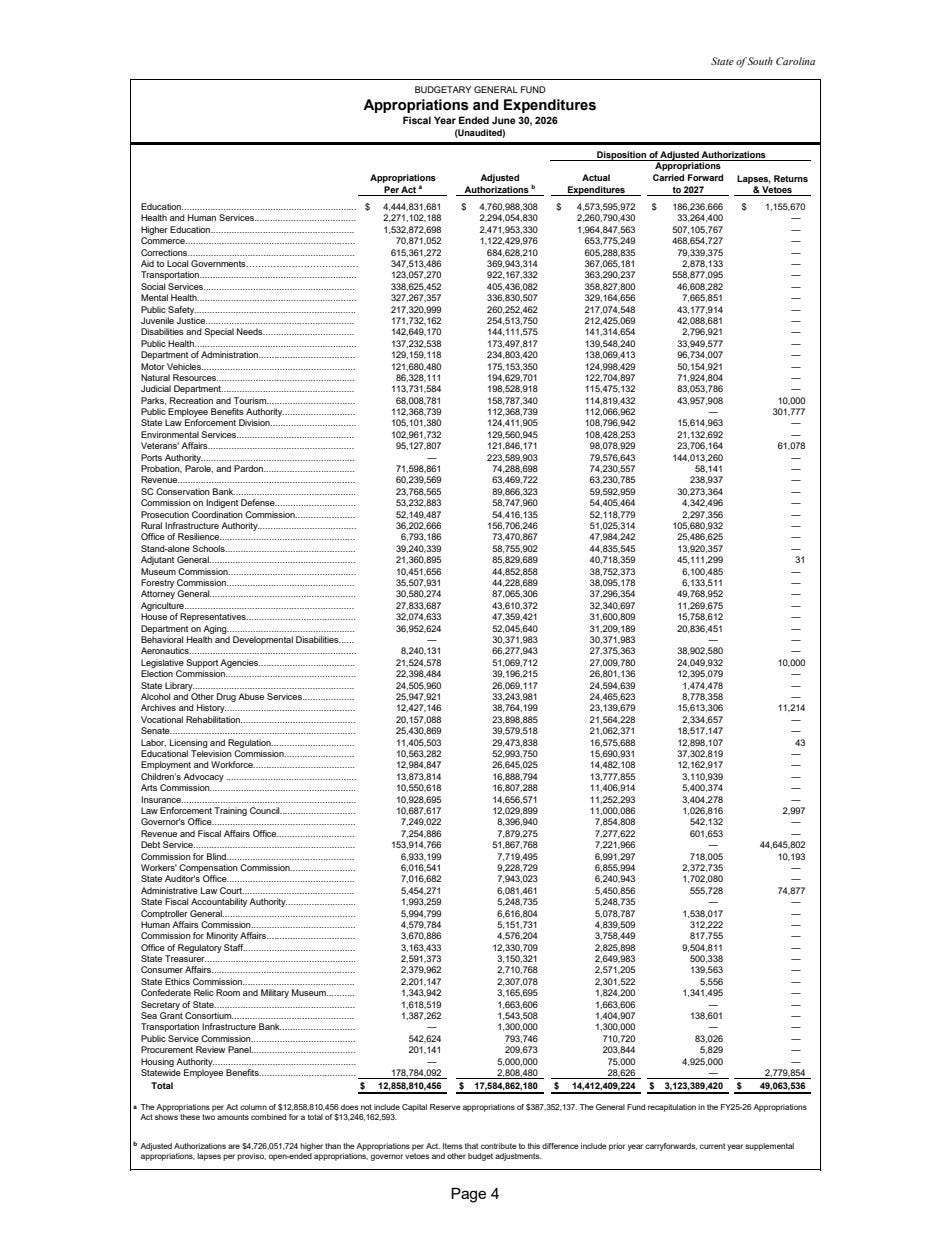
None of this is hidden. The Comptroller General publishes the report every August and posts it on his website, and any citizen can read the same page I did. But the page gives a sum for each department and nothing underneath it. It says which agencies kept money without saying which provisos let them, what it was for, how long it has been sitting, or whether the programs it paid for are still running.
I have asked legislators whether they have that breakdown. The ones I have asked do not.
So the state can tell you that $3.12 billion stayed with the agencies. It cannot or does not tell you why.
An unspent dollar that returns to the General Fund is there in January, where your legislators can put it toward roads, schools, or tax cuts. A dollar that stays with the agencies does not. It is already spoken for by a sentence somebody wrote years ago, and the argument over it happened before most people knew there was one.
You hand a contractor $1,000 for supplies for a job on your house, and the supplies come to $850. He can bring you the $150, or hold it against the next job. Either can be a fair arrangement, depending on whether you agreed to it and whether he tells you how much of your money he is holding.
That is what a lapse rule is for. It sends the leftovers back to the people who answer to voters, so they have to look at them again. When 1.5 cents comes back, the legislature is not where the decisions are being made anymore.
Which of these provisos should keep running is the legislature’s call. What this office can do is publish the list: which proviso authorized each carried-forward balance, what it was appropriated for, and how many years it has been carried. The state’s report already sorts the money by which kind of sentence let it stay, so part of that list exists somewhere.
If I am elected Comptroller General, my office will publish that list every year, agency by agency and proviso by proviso. If the accounting system does not hold the detail yet, I will work to see that it does.
Some of those balances will turn out to be doing exactly what they should. Some will not. Nobody can tell which until somebody counts.
Next week: The Count. 280 Reasons Agencies Keep $3.12 Billion of Your Tax Dollars, and Not One Explanation
Last week:
Follow the Bus Money

Third in a series on provisos, the short instructions in the state budget that move money and keep it moving.
On the lapse rule, independently stated in the State Treasurer's audited financial statements for the fiscal year ended June 30, 2025, note 2: any unexpended State General Fund monies as of June 30 automatically lapse to the State General Fund on July 1 unless the General Assembly authorizes carrying them over to the next fiscal year.
Office of the Comptroller General, year-end report, August 18, 2026, "Budgetary General Fund, Appropriations and Expenditures, Fiscal Year Ended June 30, 2026 (Unaudited)," report page 4, Total line: appropriations per act $12,858,810,456; adjusted authorizations $17,584,862,180; actual expenditures $14,412,409,224; appropriations carried forward to 2027 $3,123,389,420; lapses, returns and vetoes $49,063,536. Adjusted authorizations less expenditures is $3,172,452,956, which equals carried forward plus lapses exactly. The $49,063,536 column combines three things the report reports together: lapses, returns and vetoes. Of that total, $44,645,802 is the Debt Service line, and $2,779,854 is Statewide Employee Benefits; neither is an operating agency. The remaining $1,637,880 is spread across eleven agencies, with Education's $1,155,670 the largest. Both schedules are marked unaudited.
Prior year, equivalent schedules in the year-end report for the fiscal year ended June 30, 2025: adjusted authorizations $17,275,682,692; actual expenditures $13,830,788,672; carried forward $3,425,987,875; lapses, returns and vetoes $18,906,145. Unspent was $3,444,894,020, of which the lapses column is 0.55 percent. The $3,425,987,875 carried forward that year is the same money the FY2025 Annual Comprehensive Financial Report reports as legislatively approved agency carryover appropriations within the budgetary General Fund balance.
Same report, "Appropriations Carried Forward to FY26-27," report page 5, Total line: special carry-forwards $2,945,996,546, general carry-forwards $177,392,874, total $3,123,389,420. The report's footnotes define special carry-forwards as balances that provisos in Part 1B of the annual Appropriations Act allow certain agencies to carry forward, and general carry-forwards as the authority in proviso 117.23 to carry forward up to ten percent of original appropriations, as that proviso defines them.
Agency figures, same report, page 5: Transportation $558,877,095; Higher Education $507,105,767; Commerce $468,654,727; Ports Authority $144,013,260; Education $186,236,666. Education's lapses, returns and vetoes figure of $1,155,670 is from page 4.