


Sixth and last in a series on provisos, the short instructions in the state budget that move money and keep it moving.
One sentence in the 2000 state budget let the Governor’s School for Science and Mathematics keep the money it had not spent. Unspent money normally goes back to the state’s main account, and the legislature decides where it goes next. This sentence let the school keep it instead, and it has never said why.1 The same sentence is in the budget that took effect July 1, 2026. Only 15 of the 170 people who vote on that budget were in the General Assembly in 2000.2
The budget that took effect July 1 has 280 sentences like it, and the money kept under them came to $3.12 billion.3
In football the home team plays every week on its own field, and the visitors come to town for an afternoon and go home. That is the arrangement between the permanent state agencies that hold the state’s money and the legislature that votes on it.
The legislature comes to Columbia the second Tuesday in January, and the law sends it home by the second Thursday in May.4 This year that was January 13 to May 14, plus a handful of days after to finish the budget, the last of them August 11. Base pay for the job is $10,400 a year.5 And the roster turns over. Of the 170 members serving today, 126 arrived after 2010.6
The agencies are there all year. They keep the accounts, and every August they report to the Comptroller General, agency by agency, exactly how much they did not spend and kept.7 Nobody knows those balances better than the people running the agencies holding them, because they are the ones who wrote the numbers down.
Who those agencies answer to is a longer list than most people think. State law names 23 departments in the executive branch, and even those have four different kinds of boss, from a director the Governor appoints to an officer the voters elected to another job, like the Superintendent of Education.8 The universities, the ports, Santee Cooper, and dozens of other agencies are not on that list. Each answers to its own board, and no voter has ever elected one of those boards.9
For a lot of the agencies, keeping the money is the right call. A careful agency in the middle of a multi-year project should not have to hand the money back on June 30 and hope it comes back in July. A careful household does the same thing when it sets aside the roof money in March for a job that starts in September. Some of the $3.12 billion is exactly that, and the agencies holding it are doing what a prudent family does.
So how much of the $3.12 billion is “roof money”?
From the documents the state publishes, there is no way to know. So the home field advantage is worth somewhere between $0 and $3.12 billion. If every dollar is “roof money,” the advantage is worth nothing, and the money is sitting where it should. If none of it is, the advantage is worth $3.12 billion. The budget cannot tell you where in that range the truth falls, because the 280 sentences that keep the money do not say why it needs to stay. The Comptroller General’s August report that adds it up to the dollar does not say either.10 A taxpayer reading both documents at her kitchen table would know how much stayed and in which agency’s name, and nothing else. Same for a legislator.
A sentence goes into the budget, in a year when most of today’s members were not there, with no reason attached. The next year it is printed again. The legislature sees it for four months, inside a budget of almost six hundred pages, and votes yes or no on the whole book once.11 The agency holding the money lives with it all year and knows to the dollar what it holds. Nobody on either side did anything wrong. The reason was never written down, so nobody can go back later, follow the money, and check whether it held up.
The incentive runs one way. More money on hand is better than less, for an agency the same as for anyone, and once a sentence lets an agency keep the money, nothing in the budget ever asks the agency about it again.
You counted that money to the dollar when it was yours. It came out of your check before you saw it, and the least owed back was to know where it went and what it was for. The state can tell you that $3.12 billion of it stayed with the agencies. It cannot or does not tell you whether that was thrift or neglect, because the reason an agency should keep the money is not in the budget.
Asking what the kept money is for is the General Assembly’s job. The money is theirs to leave with the agencies or call back, and a sentence that said why, or a page that showed what each balance is for, would let the visiting team play on level ground. Until that happens, expect the home team to keep its advantage. That is a question the next budget can put on the table, and it is the kind that gets answered once somebody asks it.
The Governor can put the same question to the agencies that answer to him, and the boards and elected officers who run the rest can put it to theirs. How the next governor holds his to account could go a long way toward deciding whether the field gets level.
The Comptroller General is there all year too. When I hold that office, the page that shows what each balance is for will come out every year, agency by agency, so the visiting team walks in with the same numbers the home team has.
Footnote12
Next week: [the capstone; hook held until its title locks]
Last week: [Substack embedded preview card: 280 Reasons Agencies Keep $3.12 Billion of Your Tax Dollars, and Not One Explanation]
H.4775, the FY2000-01 General Appropriations Act, Part IB, Proviso 1.10 (SDE: Governor’s School for Science & Math): “Any unexpended balance on June 30, of the prior fiscal year of funds appropriated to or generated by the Governor’s School for Science and Mathematics may be carried forward and expended in the current fiscal year pursuant to the direction of the Board of Trustees of the School.” H.5126, the FY2026-27 act, Part IB, Proviso 10.1 (GSSM: Carry Forward), printed page 346, the same sentence with “June thirtieth” and lower-case “board of trustees of the school.” The sentence was also read in the ratified acts for FY2005-06, FY2010-11, FY2015-16, FY2019-20, and FY2025-26. The 2000 act is the earliest budget in this count; the sentence may be older. “Never said why” describes the sentence’s text in each of those acts: it states the permission and no reason for it.
Of the 124 members of the House and 46 members of the Senate as posted on scstatehouse.gov on September 4, 2026, fifteen were members of either chamber during the 1999-2000 session, when H.4775, the FY2000-01 General Appropriations Act, passed: seven in the House and eight in the Senate, two of whom served in the House at the time. Service dates are from each member’s scstatehouse.gov biography, checked against the House and Senate journal rolls of March 22 and 23 and May 11, 2000. One date is single-sourced: one member’s 2024 return to the House (the roster only).
The $3.12 billion is from the Comptroller General’s year-end report cited in note 7, page 4, appropriations carried forward to 2027: $3,123,389,420. The 280 is the count of provisos in Part 1B of H.5126 as ratified that grant an agency authority to carry unspent money past June 30, hand-checked against the ratified text on September 3, 2026, and published in this series on September 22. The pairing follows the basis this series has used since August 25: the sentences counted are the permissions in force while the money is held. The Governor vetoed one of the 280 on August 17, 2026; if the General Assembly sustains that veto the count is 279.
Constitution of South Carolina, Art. III, §9: “The annual session of the General Assembly shall convene at the State Capitol Building in the City of Columbia on the second Tuesday of January of each year.” S.C. Code §2-1-180: the regular session “shall adjourn sine die each year not later than five o’clock p.m. on the second Thursday in May,” with three listed grounds for extension. House and Senate Journals, January 13, 2026 (convened) and May 14, 2026 (adjourned sine die at 5:00 p.m.); Both chambers sat in the days after sine die to finish the budget (House Journals May 15, 18, 19, and 20; Senate Journals May 15 and 20 through 26), and on August 11, 2026, when the H.5126 conference report was adopted in both chambers and the act ratified as R.276. S.C. Code §2-1-180 was amended in 2026 by S.238 (R.127), the Governor’s veto overridden June 25, 2026, to let the President of the Senate and the Speaker call their bodies back after sine die when the appropriations bill is not finished.
H.5126, the FY2026-27 General Appropriations Act, Part IA, Section 91A, p. 217: “SENATORS @ $10,400,” $478,400 for 46 positions; Section 91B, p. 218: “REPRESENTATIVES @ $10,400,” $1,289,600 for 124 positions. S.C. Code §2-3-20 sets members’ compensation at “such sum as may be provided by law.” The 2025 Legislative Manual, p. 5, states the same figure. Members also receive subsistence for each legislative day under Proviso 91.4 and a monthly in-district allowance under Proviso 91.13; neither is added to the figure in the body.
Of the 170 members serving today, 44 were members of either chamber during the 2009-10 session at the passage of H.4657, the FY2010-11 General Appropriations Act; the other 126 arrived after. Service dates are the ones cited in note 2, checked against the House and Senate journal rolls of March 18 and April 29, 2010. One member’s November 2010 seating falls after passage and is counted among the 126.
Office of the Comptroller General, year-end report for the fiscal year ended June 30, 2026, issued August 18, 2026, “Budgetary General Fund, Appropriations and Expenditures (Unaudited),” which lists appropriations carried forward agency by agency. The prior year’s report issued August 18, 2025.
The four kinds of boss, in the statute’s words. S.C. Code §1-30-10(A) creates twenty-three departments “within the executive branch of the state government,” from the Department of Administration to the Department of Environmental Services. Subsection (B)(1) sets the governing authority of each as one of: “a director or a secretary, who must be appointed by the Governor with the advice and consent of the Senate”; “a board to be appointed and constituted in a manner provided for by law”; for Agriculture and Education, the Commissioner of Agriculture and the Superintendent of Education “elected to office under the Constitution of this State”; or, for Transportation, “a seven member commission constituted in a manner provided by law, and a Secretary of Transportation appointed by and serving at the pleasure of the Governor.”
The universities, Santee Cooper, and the Ports Authority are created by their own statutes outside §1-30-10. Three examples: the University of South Carolina’s board of trustees is sixteen members elected by the General Assembly, one appointed by the Governor, and three ex officio, among them the Governor and the Superintendent of Education (§59-117-10); Santee Cooper, the Public Service Authority, has twelve directors “appointed by the Governor with the advice and consent of the Senate” (§58-31-20); the Ports Authority’s board members, other than the Secretaries of Transportation and Commerce, are “appointed by the Governor, with the advice and consent of the Senate” (§54-3-20). None of these boards is elected by the voters; the ex officio seats are held by officers the voters elected to other offices. “Dozens”: Part IA of H.5126 appropriates to 113 sections. Twenty-three are the §1-30-10 departments; nineteen are the General Assembly, the courts, the constitutional officers, and statewide lines such as debt service; the other 71 are agencies, boards, commissions, authorities, and campuses outside the 23, or 51 on a reading that sets aside the regional campuses, the Governor’s Office agencies, and the boards that serve the legislature. The Ports Authority and Santee Cooper take no General Fund appropriation and have no Part IA section, so the count is a floor.
The range is arithmetic on the year-end report’s own figure: the low end assumes every carried dollar is held for a stated, time-limited purpose and the high end assumes none is. The report’s page 5 sorts the $3.12 billion into $2,945,996,546 of special carry-forwards under Part 1B provisos and $177,392,874 under proviso 117.23’s general ten percent authority, and states no purpose for any balance. The year-end report and the appropriations act are the two documents the state publishes that carry these figures; neither states a reason for any balance.
H.5126 as ratified runs 265 pages of Part IA appropriations, a two-page statement of revenues, and 325 pages of Part IB provisos, printed pages 1 to 592. The General Assembly adopts Part 1B with the rest of the act in one vote on the conference report, August 11, 2026: Senate 37 to 2, House 100 to 17.
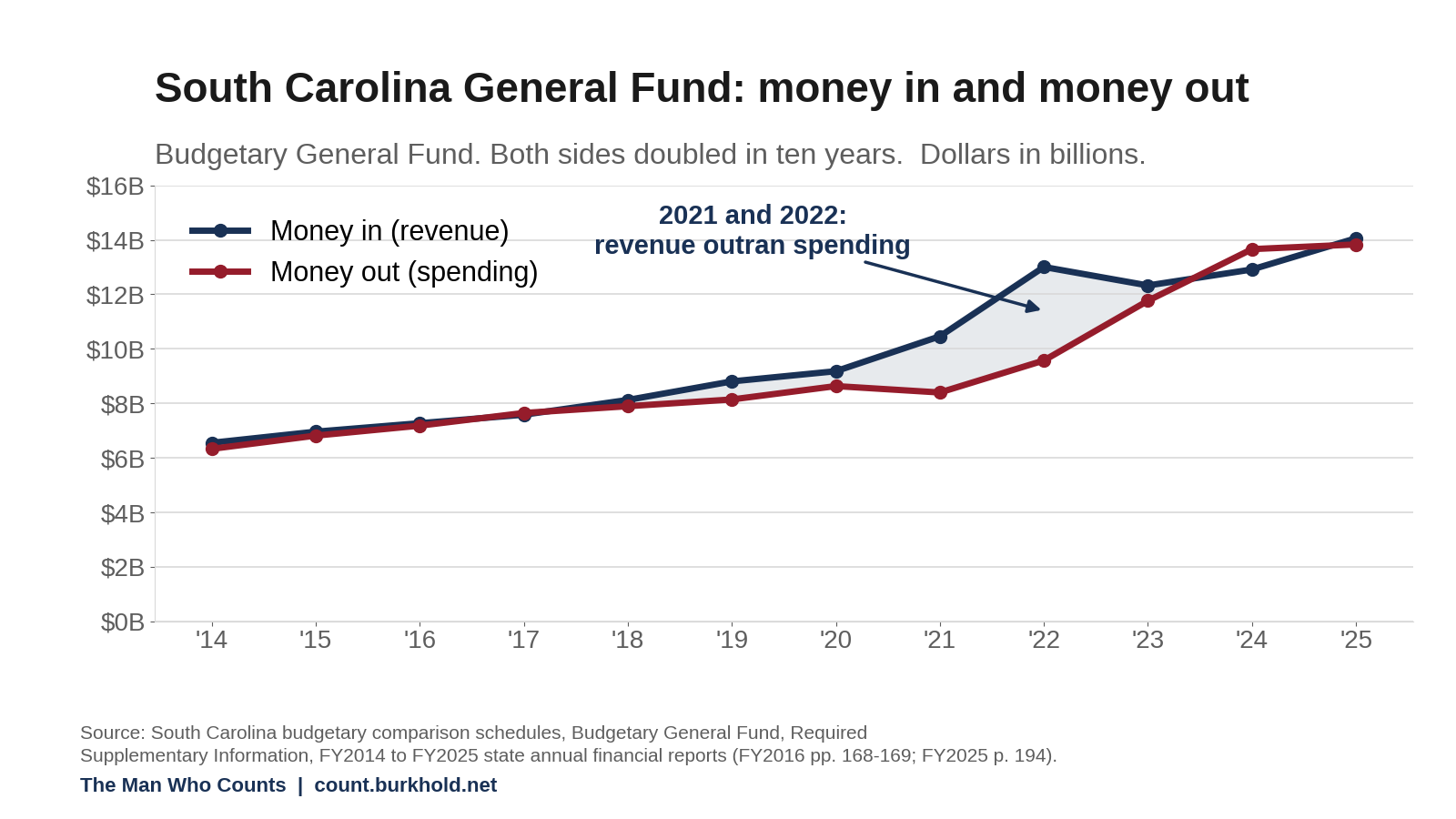
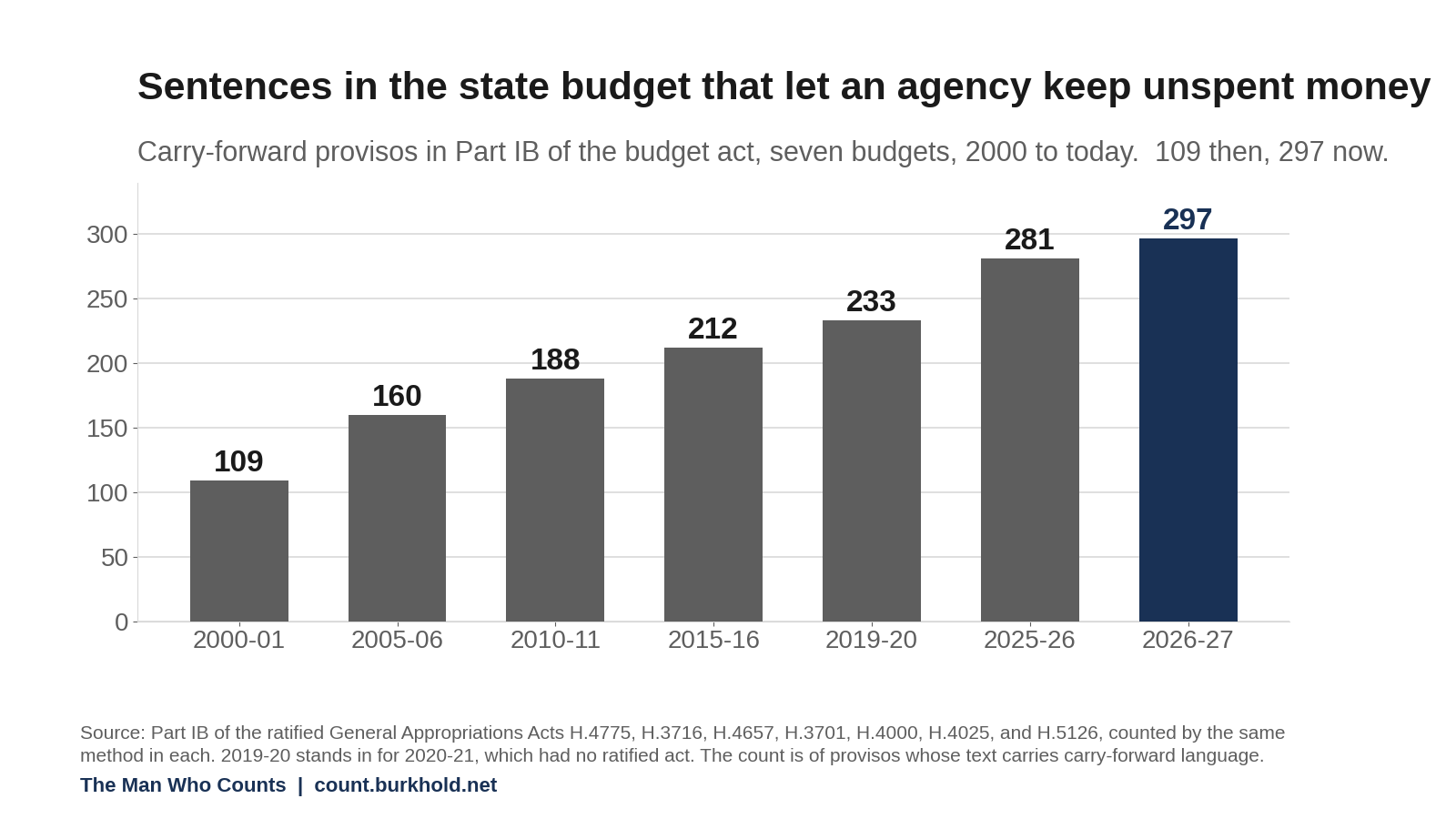
The chart counts every proviso whose text carries carry-forward language, by the same programmatic method in each of seven ratified acts: FY2000-01 (H.4775) 109; FY2005-06 (H.3716) 160; FY2010-11 (H.4657) 188; FY2015-16 (H.3701) 212; FY2019-20 (H.4000, standing in for FY2020-21, which had no ratified act) 233; FY2025-26 (H.4025) 281; FY2026-27 (H.5126) 297. The 280 in the body is this year’s count after a second pass in which each row was read and rows that mention carried money without granting the authority to carry it were removed; that pass has been run on the two most recent years only, so the series is shown on the uniform first-pass basis, on which this year is 297. The money chart is the one published in this series on August 18, from the budgetary comparison schedules in the state’s annual financial reports, FY2014 to FY2025.