


This spring the legislature passed a law, H.4216, to bring the income tax to zero. The money to end it has already been flowing into the state’s main account, which grew from $7 billion a year to $14 billion a year in ten years while the tax brought in about $6 billion.1
It makes sense to end this tax as soon as possible, and the state’s own books say it can go without another tax taking its place.
Ending the tax means more money goes home with South Carolina workers every month.2 It means no state return to fill out in April, and no state tax taken out of a pension or a paycheck.
Eight states get by without an income tax, and three of them, Florida, Tennessee, and Texas, are Southern states like ours. Both of our neighbors charge less than South Carolina charges now. North Carolina is at 3.99 percent and Georgia at 4.99.3
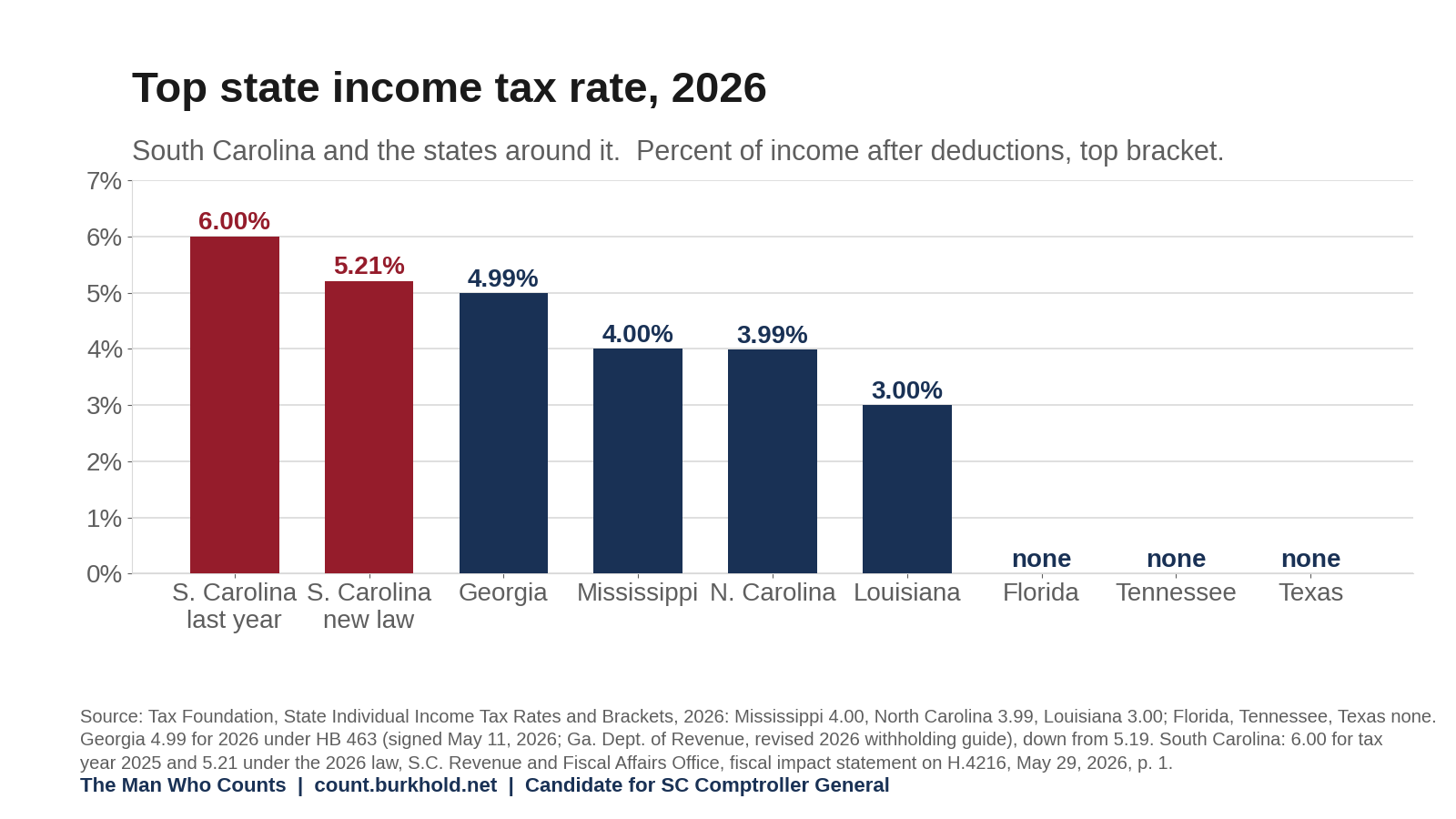
South Carolina’s top rate is not just a rich man’s rate. Last year the top rate, 6 percent, started at about $18,000 of income after deductions, so three out of four returns that owed anything owed at the top rate.4 The new law moves that line to $30,000 and the rate to 5.21 percent, and about six in ten returns that owe anything will owe at the top rate under it.5
South Carolina was the fastest-growing state in the country last year, and 66,622 more people moved in from other states than moved out.6 It grew that fast with the income tax in place, so nobody can say the tax slows growth. The case for ending it is plainer than that. The money to end it is already here, and it belongs to the people who earned it. North Carolina, Florida, Tennessee, and Texas all charge less income tax than we do. Our legislature can end the income tax without raising another one.
That law’s rule cuts the tax only in a year the state’s forecasters predict the income tax will grow 5 percent, and that forecast has not been made since 2018.7 The first year’s $308.7 million did not wait on a forecast. The legislature wrote it straight into the rates.
So the question is where the money to finish the job comes from, because a rate cut is forever, and the money to pay for it has to come in every year. It comes from the sales tax, which grows on its own as the state grows, with nothing new made subject to it.
The money is in the growth we are experiencing in South Carolina. Our main account doubled in ten years, and the state spent it as fast as it came in.8 Half of that growth was population plus inflation, what economists call popflation. The other half, about $3.4 billion a year by now, was the state choosing to spend more, and every dollar of it is a dollar the income tax could have come down instead.9
South Carolina can hold its spending to popflation, about 4 percent a year. If it does, the sales tax and the rest of what it already collects grow past what it spends. The income tax comes down by the difference, year after year, on money that came in, with no new tax on anything. Nobody has to find $6 billion. The state has to stop spending every new dollar the minute it arrives. Ten years of that is half the tax, and the road gets shorter every time the state finds spending it can stop.
Ending the income tax also changes how South Carolina recruits business. One place to look first is what the state spends to bring businesses here. Commerce hands out grants and job development credits, which let a company keep part of the income tax withheld from its new workers’ paychecks, to the companies it picks.10 The state’s own audit found that Commerce checks what those companies deliver mostly by reading what the companies report, and that it “has not found a credible way” to measure what the incentives return.
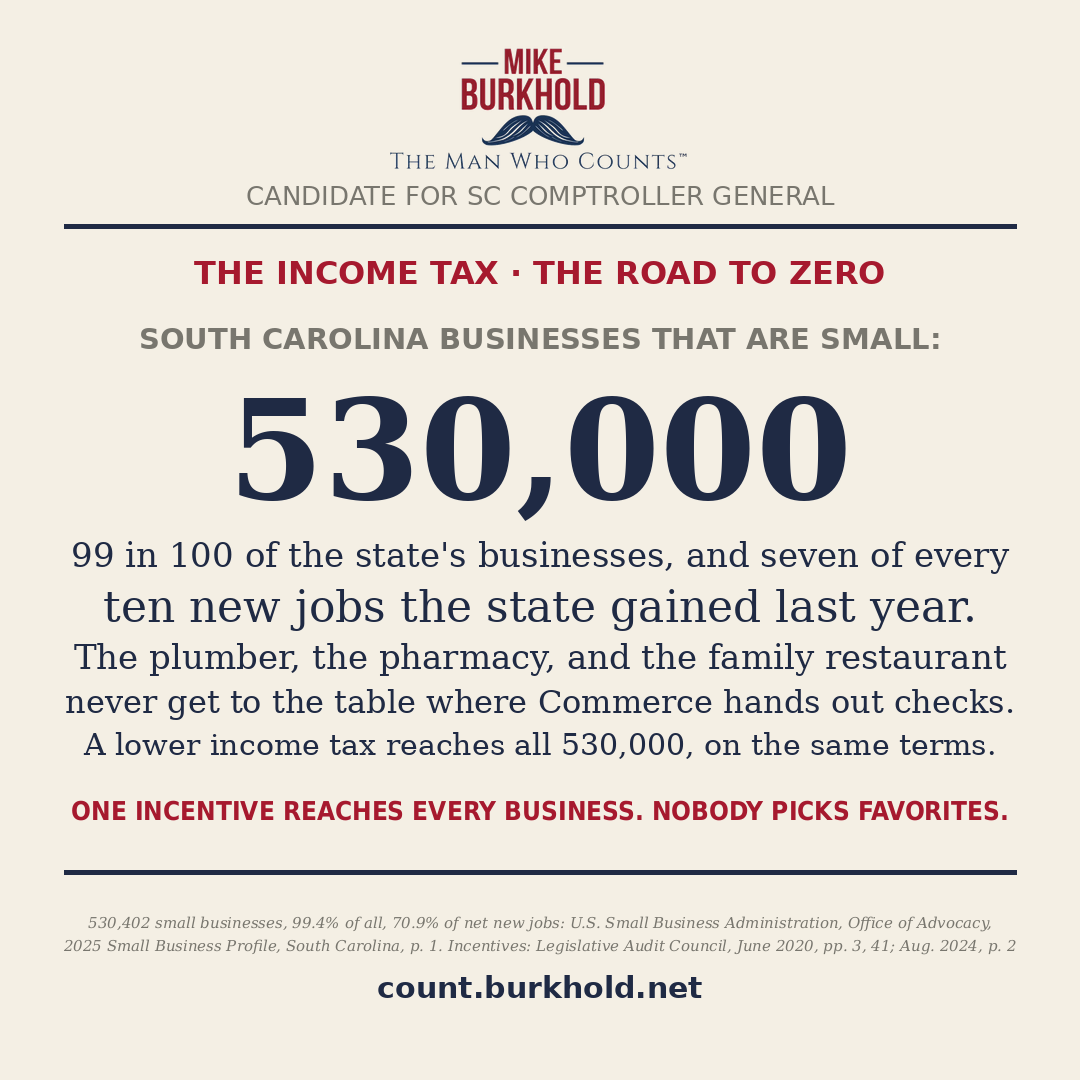
More than 530,000 of South Carolina’s businesses are small, 99 in 100 of them, and they added seven of every ten new jobs the state gained last year.11 The companies Commerce bargains with are the ones big enough to promise a plant or a headquarters; the plumber, the pharmacy, and the family restaurant never get to that table. A lower income tax reaches all 530,000 of them and the big ones too, on the same terms, with no one in Columbia picking favorites. Nobody can count how many businesses a lower income tax rate brings; the record does not say. But a state that costs less to do business in has less to make up with checks and incentives, and every check it does not have to write is a dollar closer to zero for South Carolina taxpayers.
There is also $3.12 billion agencies were given last year and did not spend, and no page in Columbia says what any of it is for.12 It can buy the tax down once; it cannot pay for a rate cut, because a rate cut comes due every year.
The state took its share of your paycheck before you saw it, every year for ten years, and every year it took in more than the year before. It could have let the income tax come down by the difference. It spent the difference instead. Hold the line on spending, count the money, and the tax can come down as fast as the money is there. The line is the legislature’s to hold. The count is the Comptroller General’s: what each agency is holding, what each dollar of it is for, and how much is left over from business that is finished, on one page anyone can read.
Next week: We Can’t Run an Excellent Government Without Reliable Financials
Last week:
One Page to Justify Billions of Dollars

Last year’s state budget gave the Department of Commerce $71 million from the General Fund, the state’s main account. When the year ended June 30, Commerce carried $469 million forward.
Budgetary-basis General Fund revenue, net of the transfer to the Trust Fund for Tax Relief, from the Growth Source Banking Log v9.6 (August 11, 2026), flows series, endpoints image-confirmed: FY2015 $6,960,389 thousand (FY2015 CAFR, pp. 158-159) and FY2025 $14,057,744 thousand, the difference $7,097,355 thousand. The FY2025 figure is also the Board of Economic Advisors’ “Net General Fund Revenue” for FY 2024-25, $14,057,743,518, on its “General Fund Revenue Forecast as of May 19, 2026,” p. 2 (rfa.sc.gov/media/11516; page image confirmed September 23, 2026). “Ten years” is FY2015 to FY2025, the latest audited year. The individual income tax: $6,722,186,938 collected in FY 2024-25 before the trust-fund transfer (BEA table, p. 1; S.C. Department of Revenue, 2024-2025 Annual Report, p. 5, gives $6,722,186,937), and about $5.9 billion after it, the basis on which it sits inside the $14 billion; the combined individual and corporate transfer that year was $800,815,175 (BEA table, p. 2). The $7.1 billion exceeds the tax on either basis. This is the increase in the account’s yearly revenue over ten years set against one year of income tax.
What the tax costs a household, for the reader who asks: S.C. Revenue and Fiscal Affairs Office, Statement of Estimated Fiscal Impact, H.4216, signed by the Governor March 30, 2026, impact date May 29, 2026, Table 1, total row: new average tax liability $2,209 across all 2,757,573 returns, including the 35 percent that owe nothing. Second anchor: the Department of Revenue’s tax year 2024 total liability, $5,950,104,066 (Annual Report, p. 7), over its 2,672,816 returns (p. 9), is $2,226 per return. Per return that owed anything, about $3,800. “4 in 10 returns that owe nothing”: 1,107,177 of 2,672,816, 41.42 percent (Annual Report, p. 7).
Tax Foundation, “State Individual Income Tax Rates and Brackets, 2026,” table as of January 1, 2026, data as of February 11, 2026: eight states with no individual income tax (Alaska, Florida, Nevada, New Hampshire, South Dakota, Tennessee, Texas, Wyoming); Washington is listed separately as taxing capital gains only. North Carolina 3.99 percent flat as of January 1, 2026. Georgia: 5.19 percent on the Tax Foundation’s table as of February 11, 2026; reduced to 4.99 percent for tax year 2026, retroactive to January 1, by HB 463, signed May 11, 2026, with annual reductions toward 3.99 percent beginning 2027 (Georgia Department of Revenue, revised 2026 Employer’s Withholding Tax Guide, June 2026; Bloomberg Tax, May 13 and June 9, 2026; Tax Stance banking log A25). Both neighbors under South Carolina’s 5.21. South Carolina’s top rate was 6 percent for tax year 2025 (RFA statement on H.4216, p. 1; RFA press release, November 18, 2025) and is 5.21 percent under the 2026 law. The rates for every state named in the piece are on the chart with the essay.
Brackets: for tax year 2026 the state’s rates were 0 percent up to $3,640 of taxable income, 3 percent to $18,230, and 6 percent above (RFA statement on H.4216, Table 1 note; Tax Foundation 2026); tax year 2024’s thresholds were lower, since the brackets are indexed. At an $18,230 floor the tax owed is 3 percent of ($18,230 minus $3,640), about $438, before credits. So any return that owed more than $500 had taxable income above the floor and was taxed at the top rate. The Department of Revenue’s tax year 2024 table of returns by tax liability (2024-2025 Annual Report, p. 7; page image confirmed September 23, 2026) shows 1,197,827 returns owing more than $500, which is 76 percent of the 1,565,639 returns that owed anything and 45 percent of all 2,672,816 returns. The count is a floor: returns in the $438 to $500 band, and returns whose credits pulled a top-bracket liability under $500, are excluded. “About $18,000”: $18,230. The new law’s top bracket begins at $30,000 (RFA statement, p. 1).
Who still pays the top rate under the new law: a return with $30,000 of taxable income owed about $1,144 under the 2026 brackets (3 percent of $18,230 minus $3,640, plus 6 percent of $30,000 minus $18,230) and about $1,176 under tax year 2024’s lower indexed thresholds, before credits; so any return owing more than about $1,150 had taxable income above $30,000. The Department of Revenue’s tax year 2024 table (Annual Report, p. 7, image-closed) shows 932,857 returns owing more than $1,250, which is 59.6 percent of the 1,565,639 returns that owed anything; counting the whole $1,001 to $1,250 band would make it 64.8 percent. “About six in ten” is the floor. Under the new law, taxable income above $30,000 is taxed at 5.21 percent (RFA statement, p. 1).
U.S. Census Bureau, press release, “Nation’s Population Growth Slows” (Vintage 2025 estimates), January 27, 2026: “Fueled by a sizeable net domestic migration increase of 66,622, South Carolina’s population grew by 79,958 between July 1, 2024, and July 1, 2025,” 1.5 percent, the highest rate of any state; Idaho 1.4 and North Carolina 1.3 followed. Tie: S.C. Department of Employment and Workforce, “South Carolina Records Fastest Population Growth in the Country,” February 17, 2026, same figures; the Census July 1, 2025 total, 5,570,274, is the population endpoint in note 8. “Nobody can say the tax slows growth” is the record’s own limit on the argument: the growth happened under a 6 percent top rate, and the piece makes no claim that ending the tax will change the rate of growth. “All charge less income tax than we do”: North Carolina 3.99 percent; Florida, Tennessee, and Texas none; South Carolina 5.21 percent under the 2026 law (note 3).
S.C. Revenue and Fiscal Affairs Office, Statement of Estimated Fiscal Impact, H.4216, signed by the Governor March 30, 2026, impact date May 29, 2026, pp. 1-2: tax year 2026 rates of 1.99 percent on taxable income up to $30,000 and 5.21 percent above; “The bill will reduce individual income tax liability by approximately $308,700,000 in tax year 2026”; General Fund impact ($308,700,000) in FY 2026-27. The rule for later years, p. 1: rates “will be reduced annually beginning in tax year 2027 if individual income tax revenue, less amounts credited to the Trust Fund for Tax Relief, is projected to grow by at least 5 percent in the following fiscal year,” each reduction sized “to reduce individual income tax revenue by approximately $200,000,000 or 25 percent of the recurring income tax revenue surplus, whichever is greater,” limited to the projected increase where that is under $200,000,000, on the February 15 forecast. The enrolled text of H.4216, Section 12-6-510(C)(3), sets the figure as “two hundred million dollars” and contains no inflation adjustment or index (scstatehouse.gov/sess126_2025-2026/bills/4216.htm, read September 23, 2026); the 25 percent alternative scales with the surplus and applies only when it exceeds $200 million. “About $200 million”: the 25 percent rule exceeds $200 million only when projected growth exceeds $800 million, about 13 percent on a $6 billion base. A 5 percent year on about $6 billion is about $300 million, so in a year the law works the tax grows about $100 million net of the cut; in a year under 5 percent the law does nothing. The BEA’s May 19, 2026 forecast, made before the law’s adjustments, has the tax growing 0.6 percent this year and 1.3 percent next.
Growth Source Banking Log v9.6, flows and deflators, all endpoints image-confirmed: revenues +102.0 percent and expenditures +102.9 percent, FY2015 to FY2025. Population July 1, 2015, 4,896,006 (Census intercensal estimates via the S.C. Revenue and Fiscal Affairs Office State Data Center) to July 1, 2025, 5,570,274 (Census Vintage 2025, released January 27, 2026), +13.77 percent. CPI-U, all items, U.S. city average, not seasonally adjusted, June 2015 238.638 to June 2025 322.561 (BLS releases of July 17, 2015 and July 15, 2025), +35.17 percent. Keep-pace factor 1.5378, “about half.” The other half, $3,354,058 thousand on revenues (note 9), is growth beyond people and prices. Annualized, spending about 7.3 percent a year against about 4.4 for people and prices; the body says “about 4” and “7.”
“About $3.4 billion a year by now” and “ten years of that is half the tax”: Growth Source Banking Log v9.6: population +13.77 percent and CPI-U +35.17 percent, FY2015 to FY2025 (inputs in note 8); keep-pace factor 1.5378. Arithmetic: FY2015 revenue $6,960,389 thousand times 1.5378 is $10,703,686 thousand, the revenue that would have kept pace with people and prices; FY2025 actual $14,057,744 thousand exceeds it by $3,354,058 thousand, “about $3.4 billion a year.” Against the individual income tax that is 57 percent of the $5.9 billion net figure and 50 percent of the $6.7 billion gross figure, “about half.” “Ten years of that is half the tax” (the road paragraph) is the same arithmetic stated forward; no projection beyond the past decade’s own rates is made.
Job development credits: Legislative Audit Council, Review of Incentive Programs Administered by the S.C. Department of Commerce, June 2020, p. 3: JDCs “are tax rebates that businesses can take against their employee withholdings on their quarterly state withholding tax returns”; p. 25: “JDC funds are rebates from the employee withholding taxes.” Legislative Audit Council, Review of Incentive Programs Administered by the S.C. Department of Commerce, June 2020: “the only evidence DOC uses to verify companies’ job creation/retention is documentation provided by the company, itself” (p. 41); site visits halted September 2018 and resumed when the audit began (p. 42). Follow-up report, August 2024: of 39 recommendations, 17 implemented, 6 partial, 14 not implemented (p. 1); the retrospective return analysis (Recommendation 10) declined, Commerce stating it “has not found a credible way” to do it (p. 2); additional verification of claimed jobs “not practical” (p. 2). Both reports are project files, banked for The Money That Never Came Back (July 14), The Honor System (July 21), and The Second Inspection (July 28); the quotes are as banked there. Concession, as in those pieces: the Council’s own history shows 289 finished grants, 2015 to 2025, at 115 percent of required jobs and 139 percent of required investment, on company-certified numbers (CCED 2025 Annual Report, p. 25). “A lower income tax is an incentive too”: stated as reasoning, not as a measured effect; the piece makes no claim about how many businesses a rate change brings. Basis for “costs less to do business in”: S.C. Code 12-6-545 (read September 25) lets a pass-through owner elect a 3 percent rate on active trade or business income, but excludes amounts reasonably related to the owner’s own services, which stay at the individual rates; H.4216 does not amend it. The individual rate is what a business owner pays on the labor half of the business’s income and on every wage it pays.
U.S. Small Business Administration, Office of Advocacy, “2025 Small Business Profile: South Carolina” (advocacy.sba.gov, June 2025), p. 1: 530,402 small businesses, 99.4 percent of South Carolina businesses; 863,326 small business employees, 42.9 percent of the state’s employees; between March 2023 and March 2024 the state’s establishments added a net 35,780 jobs, of which small businesses contributed 25,358, 70.9 percent (source data: Census Nonemployer Statistics and Statistics of U.S. Businesses; BLS Business Employment Dynamics). “Small” in the SBA’s count is a firm with fewer than 500 employees, and 98 percent of the 530,402 have fewer than 20. “Last year” is the profile’s latest year, March 2023 to March 2024. “Never get to that table” is the mechanism, not a count: a Commerce grant or job development credit is negotiated per project against job and investment commitments (LAC 2020, ch. 2), which is not a transaction a firm of a few employees enters; the piece does not claim no firm under 500 employees has ever received one. Banked at Tax Stance log A27; the primary PDF’s own text read September 25.
Office of the Comptroller General, year-end report, August 18, 2026, “Budgetary General Fund, Appropriations and Expenditures, Fiscal Year Ended June 30, 2026 (Unaudited),” p. 4, Total line: appropriations carried forward to 2027, $3,123,389,420 (Keeping the Change banking log v7, B2). Page 5 sorts it into $2,945,996,546 of special carry-forwards and $177,392,874 of general carry-forwards and states no purpose for any balance. General Fund only.