


The state of South Carolina paid $635,600 to get two computer labs ready for children who had no internet at home. Neither lab ever opened.
In 2021, the state had federal money to spend and a good reason to spend it. The pandemic had sent more than $48 million in education relief into South Carolina. In March of that year, the Governor’s Office handed the University of South Carolina $6 million of it to build Apple computer labs around the state, in the places where the internet runs thin and a child’s homework depends on a signal that is often not there.
Some of those labs opened. There are iCarolina labs today on university campuses, in local libraries, and at Benedict College. That part worked, and it mattered.
Two of the labs never opened at all. The state spent $635,600 getting them ready.
Here is where that money went. The university paid $190,200 to lease space in the USC/Columbia Technology Incubator, a downtown building, and another $409,400 on a services agreement with the Incubator to hire staff, market the lab, and fit out the rooms. The lab never opened. The City of Columbia later cancelled the lease on the building.
The second lab was smaller. The university signed a three-year, $36,000 lease with the South Carolina Research Authority for a room at the McNair Center to hold an Apple lab. After the university stopped running online classes in that room, the lab sat unused.
Add it up and you get the same $635,600. Two leases, a staffing contract, and not one open lab.
Put it in terms you live with. You hire a contractor to put a new roof on your house. You pay him up front. The shingles get delivered and stacked in your driveway. Then the roof never goes on. The contractor got paid. The supply yard got paid. You are still standing in the kitchen with a bucket every time it rains. That is the $635,600. Everyone in the chain got their money, and the thing the money was for never showed up.
None of this is hidden. It comes from a public audit. The Legislative Audit Council, the legislature’s own auditors, reviewed this grant at the request of a bipartisan group of senators and found $1.7 million in questionable transactions inside it. The empty labs are the first $635,600 of that.
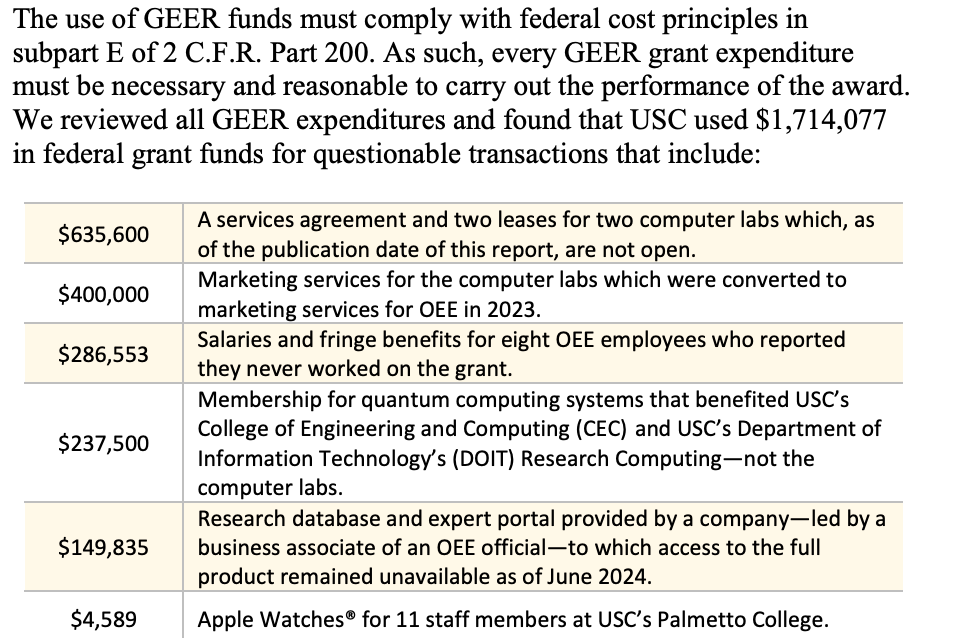
The university disputes the findings. Its president has said the spending was necessary, reasonable, and appropriate, that the office made its best efforts, and that some of the money went to outside organizations not under the university’s legal authority. He is entitled to that, and it deserves a fair hearing. But best efforts describe the trying. What this grant was meant to buy was open labs for children without the internet, and these two never opened. And if part of what went wrong is that the money flowed out to organizations the university could not fully control, that points straight at the problem rather than away from it.
So how does $635,600 walk out the door with nothing to show for it, when no one set out to waste a dime? I doubt a single person at USC did. The answer is older than this grant, and Milton Friedman put it best. There are four ways to spend money. When people spend their own money on themselves, they watch the price and they watch what they get. When they spend their own money on someone else, they still watch the price, but they care less about the result. When they spend someone else's money on themselves, they stop watching the price but still mind what they get. And when they spend someone else's money on someone else, they watch neither, because they have no reason to.
That is the box this money sat in from the start. It was not the university’s money. It came from Washington, though it started in your paycheck and mine. It was spent by one set of hands, routed through a nonprofit, on labs for children none of those hands would ever sit a child down in front of. Nobody in that chain was spending his own money on his own house.
So nobody stood at the end and asked the one question that decides everything. Did a lab open. Of course the shingles ended up in the driveway. That is what the fourth box does, every time, in every government, to anyone who stands in it. Not a character flaw. A structure.
And that is the whole difference between that money and yours. When it was yours, it sat in the first box. You watched the price and you watched what you got, because you earned it and there was never a dollar to spare. The morning a roofer left your shingles in the driveway and drove off, you would have been on the phone before lunch. You counted every dollar of that money when it was yours. The minute it left your hands, nobody counted it again.
That is the job I am running for, and it is why I am going to write this every week. Every story will come from a public document you can pull up and read yourself, the way I pulled this audit. No anonymous sources, no rumors, no guessing at what anyone meant. The record, in plain words, with the math shown.
Because the labs that never opened are one small piece of something bigger. Money in South Carolina has a way of vanishing the moment it leaves the state’s own books and moves somewhere harder to watch. At a university. At a charter school office. At an agency you have never heard of. And in the end, in the state budget itself. Different places, same disease.
The cure is the same every time. Somebody has to keep the count, stand at the end, and say what your money bought.
Next week: The Eight Who Never Worked.
---
Source: South Carolina Legislative Audit Council, A Review of the Office of Economic Engagement of the University of South Carolina and its Affiliation with the USC/Columbia Technology Incubator and the South Carolina Research Foundation (December 2024). Read it: https://lac.sc.gov/node/271
Thank you, sir. This is the kind of transparency (and accountability) needed at ALL levels of our government. I look forward to more and supporting your candidacy.
PS I will share with our own state rep and senator.
This is impressive research! Looking forward to reading more of it. Ideally with less Milton Friedman. 😂 I don’t disagree with your point on that, but I wouldn’t go so far as to say it’s a universal truth that people are sloppy with money from elsewhere. Think it depends on the situation. And always need more accountability baked in.
It’s also worth noting that contracting out state work to nonprofits is the public-private partnership model generally touted by conservatives as being superior to government-run, and I don’t think that’s necessarily always true either.
Anyway, it’s cool that you’re doing all this. I look forward to reading more of your work!