

Earlier this year the legislature cut South Carolina’s income tax rates outright. It wrote the new rates into the law itself, a law called H.4216, and the cut came to $308.7 million in the first year.1 That took a session of work, and it is a real cut, the kind that shows up in a paycheck. The same law promises to keep cutting every year until the tax is gone. That second half of the promise runs on a rule, and the rule has a math problem.2
The law reads this way. The rate comes down only in a year the state’s forecasters project income tax collections to grow at least 5 percent. When that happens, the rate drops by enough to cost about $200 million, or a quarter of the growth if that comes to more, which would take a year of 13 percent growth. In a year projected to be under 5 percent growth, nothing happens. On top of this, the $200 million is written in dollars, and the law never adjusts it for inflation, so ten years from now the same cup is worth about $150 million in today’s money.3
Let’s say the income tax is a bathtub holding about $6 billion.4 In a good year, one that qualifies for the cut, the faucet pours in $300 million and the law dips out $200 million with a cup, so the water rises $100 million. In a 10 percent year the faucet pours in $600 million, the cup is the same $200 million, and the water rises $400 million. In an ordinary year the law never picks up the cup, and the faucet keeps running. The rule, on its own, never lowers the water. It never takes out more than it expects the faucet to put in. A bad year can lower the tub. The rule cannot.
So the one real dip came from the legislature’s own hand, not from the rule. The $308.7 million cut in 2026 is more than the rule would allow in any year the forecasters have ever predicted. The legislature can cut when it decides to. The rule, left to itself, cannot be counted on to.
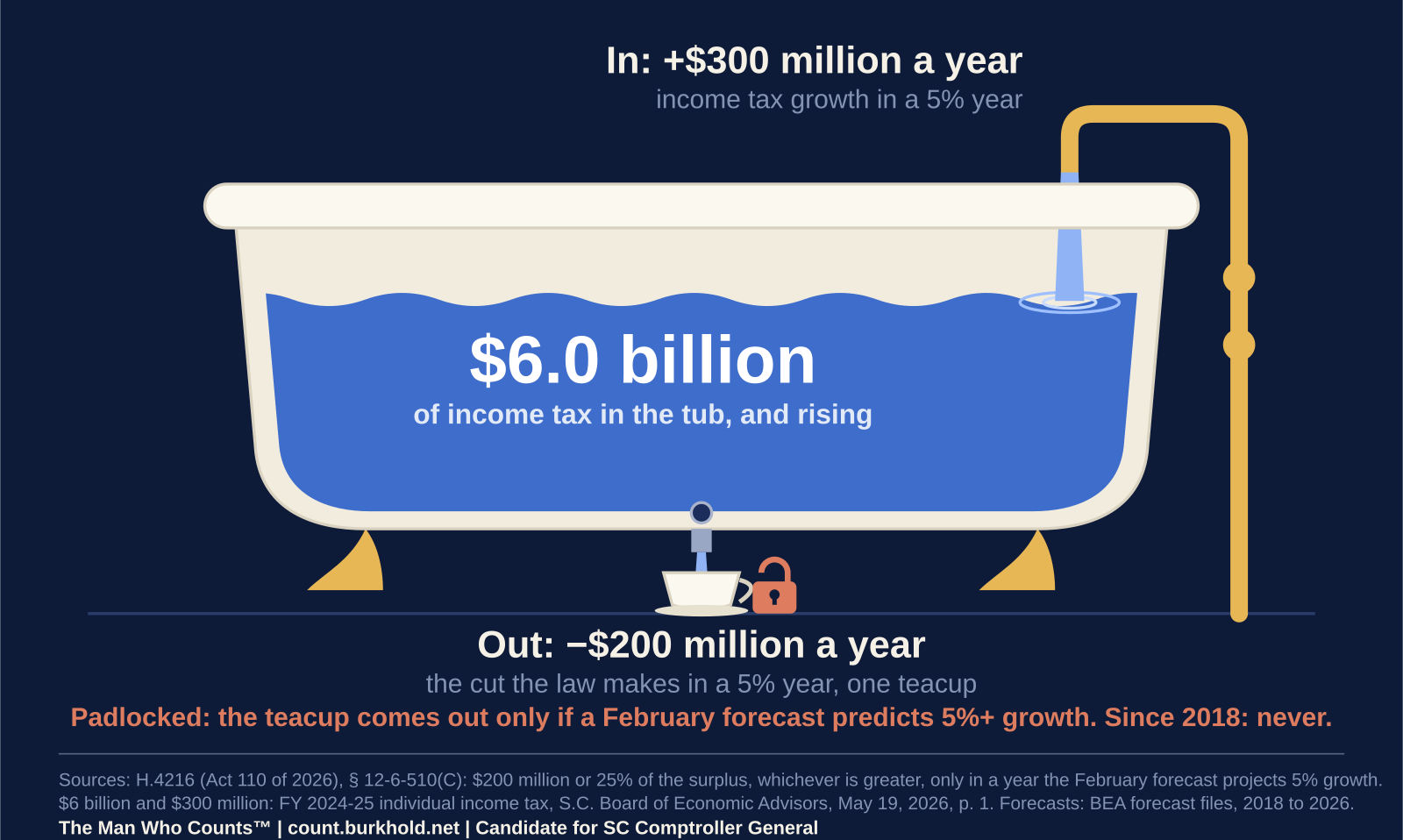
The state’s own forecasters, in May, predicted the tax would grow 0.6 percent this year and 1.3 percent next.5 Neither reaches 5. Under the rule the cup stays on the shelf for the next two years, and the faucet runs at a trickle. So on the state’s own numbers, the next two years bring more income tax and no further cut from the rule.
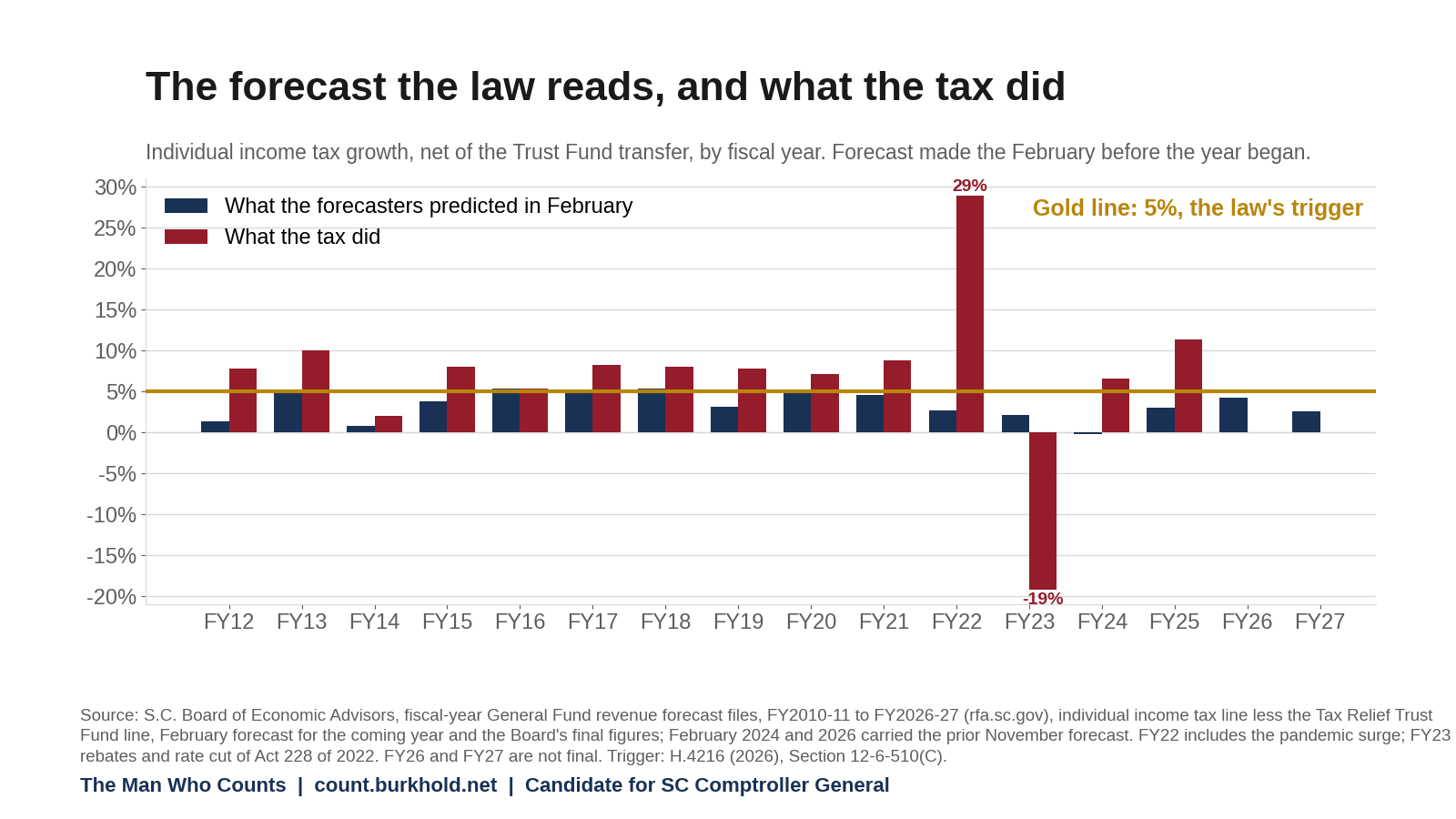
The cup’s use depends on the forecast, and the forecast runs low. In the nine Februaries since 2018, the Board of Economic Advisors has not once predicted the income tax growing 5 percent in the coming year. The tax went on to grow 5 percent or more in six of the seven years that have finished since, and beat the February number in all six.6 Over sixteen years the February forecast has reached 5 percent three or four times, the last in 2017, while the tax itself grew 5 percent or more in twelve years out of fourteen. The forecasters are cautious on purpose, and the state runs surpluses because they are. The law hands the trigger to the cautious number.
And the cup shrinks. Two hundred million dollars is about 3 percent of the tax today. Pay goes up, prices go up, the tub fills faster, and a cup that never grows takes out a smaller share every year.7
The law says the rate comes down until it is gone, and it says nothing about when.[8] The state’s fiscal note, the cost estimate its economists attach to every bill, does not say when either. It could not, because the answer depends on how many boom years the forecasters predict, and the rule moves only on the prediction.
Every dollar in that tub came out of your paycheck before you saw it. The legislature has already shown it can lower the water. It did it this year, by its own hand. The state keeps running surpluses, and the forecast that runs the rule has not said 5 percent since 2017. So the work this coming session isn’t finding the money. It’s fixing the trigger. The legislature wrote the first cut itself. It can write the rest the same way.
S.C. Revenue and Fiscal Affairs Office, Statement of Estimated Fiscal Impact, H.4216, signed by the Governor March 30, 2026, impact date May 29, 2026, pp. 1-2: tax year 2026 rates of 1.99 percent on taxable income up to $30,000 and 5.21 percent above, in place of the prior 0, 3, and 6 percent; “The bill will reduce individual income tax liability by approximately 308,700,000intaxyear2026”;GeneralFundimpact(308,700,000) in FY 2026-27. The rule for later years begins in tax year 2027. “More than the rule would allow in any year the forecasters have ever predicted”: the rule’s cut is $200 million or a quarter of the surplus; a quarter of the surplus exceeds $308.7 million only when projected growth exceeds $1.23 billion, about 20 percent; the highest February forecast in sixteen years is 5.4 percent (note 6).
S.C. Revenue and Fiscal Affairs Office, Statement of Estimated Fiscal Impact, H.4216, p. 1: beginning in tax year 2027 the rates are reduced "if individual income tax revenue, less amounts credited to the Trust Fund for Tax Relief, is projected to grow by at least 5 percent in the following fiscal year," each reduction sized "to reduce individual income tax revenue by approximately 200,000,000 or 25 percent of the recurring income tax revenue surplus, whichever is greater.""300 million": 5 percent of about $6 billion, the individual income tax net of the trust-fund transfer (note 4). Arithmetic on the rule: when the trigger is met the growth is at least 5 percent of the base, which is more than $200 million on any base above $4 billion, and a quarter of the growth is always less than the growth; so a reduction under the rule is always smaller than the growth that triggered it, and collections after the cut exceed the prior year's. When the trigger is not met there is no reduction. Under the rule alone, therefore, projected collections never fall from one year to the next; that is the claim that the rule never lowers the water. Actual collections can fall for reasons outside the rule, as in FY2023.
Enrolled text of H.4216, Act No. 110 of 2026 (R117), ratified March 25, 2026, approved March 30, 2026, Section 12-6-510(C), scstatehouse.gov/sess126_2025-2026/bills/4216.htm, read September 23 and 24, 2026; the act carries no short title: “two hundred million dollars in the fiscal year that begins during the tax year or twenty-five percent of the recurring income tax revenue surplus for the fiscal year that begins during the tax year, whichever is greater”; the reduction is limited to the projected increase where that is under $200 million; the determination is made on the February 15 forecast; the section contains no inflation adjustment or index. “A year of 13 percent growth”: a quarter of the growth exceeds $200 million only when growth exceeds $800 million, which is 13 percent of $6 billion. “In a 10 percent year”: growth of $600 million on $6 billion; a quarter of it is $150 million, so the cut is the $200 million floor and the tax grows $400 million net. “About $150 million in today’s money”: $200 million deflated ten years at 2.5 percent a year, the Board of Economic Advisors’ own inflation assumption for FY 2026-27 (BEA forecast meeting, November 18, 2025, Economic Indicators table), is $156 million; at the last ten years’ actual CPI-U pace, 35.17 percent over FY2015 to FY2025 or about 3.1 percent a year, it is $148 million.
Individual income tax collections, FY 2024-25: $6,722,186,938 before the transfer to the Trust Fund for Tax Relief (Board of Economic Advisors, “General Fund Revenue Forecast as of May 19, 2026,” p. 1, rfa.sc.gov/media/11516; S.C. Department of Revenue, 2024-2025 Annual Report, p. 5, gives $6,722,186,937), and about $5.9 billion after it, which is the figure the trigger measures. “About $6 billion” on either basis.
Board of Economic Advisors, “General Fund Revenue Forecast as of May 19, 2026,” p. 1, Individual Income Tax row: FY 2024-25 final $6,722,186,938; FY 2025-26 estimate $6,762,575,000, +0.6 percent; FY 2026-27 estimate $6,847,487,000, +1.3 percent. Net of the Trust Fund line the same estimates are about 0.5 and 1.3 percent. The table’s note: “Figures do not include legislative adjustments enacted in 2026,” so the forecast is before the law’s first-year cut; the rule’s own test uses the February 15 forecast, the next of which is February 2027.
Board of Economic Advisors, fiscal-year General Fund revenue forecast files, FY2010-11 through FY2026-27, at rfa.sc.gov, “General Fund Revenue Reports and Forecasts.” The law’s test is the February forecast of the upcoming fiscal year’s individual income tax growth “less amounts credited to the Trust Fund for Tax Relief,” so each year’s figure is the next-year estimate minus the next-year Trust Fund line, over the current-year estimate minus the current-year Trust Fund line, both from the same February table. Net forecasts, February 2018 through 2026: 3.1, 4.9, 4.6, 2.7, 2.1, minus 0.2, 3.0, 4.2, 2.6 (2024 and 2026 carried the prior November’s figures, per the Board’s February 15, 2024 release and February 12, 2026 minutes). Net actual growth, FY2019 through FY2025: 7.8, 7.1, 8.8, 28.9, minus 19.2, 6.6, 11.4; FY2022 includes the pandemic-era surge and FY2023 the rebates and rate cut of Act 228 of 2022. Over the full run, February 2011 through 2026, the net forecast reached 5 percent in 2012 (5.0), 2015 (5.3), 2016 (5.1), and 2017 (5.4); the Board’s Trust Fund line is the whole statutory transfer, of which RFA’s own split charges about 98 percent to the individual tax, and on an individual-only deduction the 2012 figure could fall just under 5, which is why the body says three or four. Net actual growth reached 5 percent in twelve of the fourteen completed years, FY2012 through FY2025, all but FY2014 and FY2023. The Board on its own caution, February 12, 2026 minutes: “The current revenue excess of $90 million is much lower than in any of the excesses reported in the past six February meetings.”
“About 3 percent”: $200 million is 3.0 percent of $6.7 billion gross and 3.4 percent of $5.9 billion net. The absence of indexing is in note 3. No projection of future growth is made; the sentence states the arithmetic of a fixed dollar figure against a growing base.
[8] S.C. Revenue and Fiscal Affairs Office, Statement of Estimated Fiscal Impact, H.4216, p. 1: the reductions continue “until the 5.21 percent tax rate is reduced to 1.99 percent, at which time the 1.99 percent tax rate will be reduced until it is eliminated.” The statement gives no year for elimination and no estimate of how many reductions will occur; its revenue table runs through FY 2027-28.
Fiscally aware - yeah! Maybe our next Governor