


Fifth in a series on provisos, the short instructions in the state budget that move money and keep it moving.
On page 469 of the state budget that took effect July 1, the Office of Resilience gets permission to keep money it didn’t spend. The permission is one sentence long and gives no reason. The office “shall be authorized to carry forward unexpended funds from the prior fiscal year into the current fiscal year.“ Farther down the page, one sentence about one of the office’s projects says the money “shall expire at the end of the fiscal year and may not be carried forward.“ No reason there either.
The second sentence is the only one of its kind in the budget. We counted.1
Money the legislature gives an agency for a year is that year’s money. When June 30 passes, whatever an agency has not spent goes back to the General Fund, the state’s main account, for the legislature to decide on again. That has been the rule for decades.2 The exception is a sentence. If the budget has a sentence saying this agency can keep this money past June 30, the agency keeps it. Those sentences are provisos.
Last year’s budget carried 269 of them. This year’s carries 280.3 4The money kept under them came to $3.12 billion.5 In one year the legislature wrote thirteen new permissions to keep money and took two away.
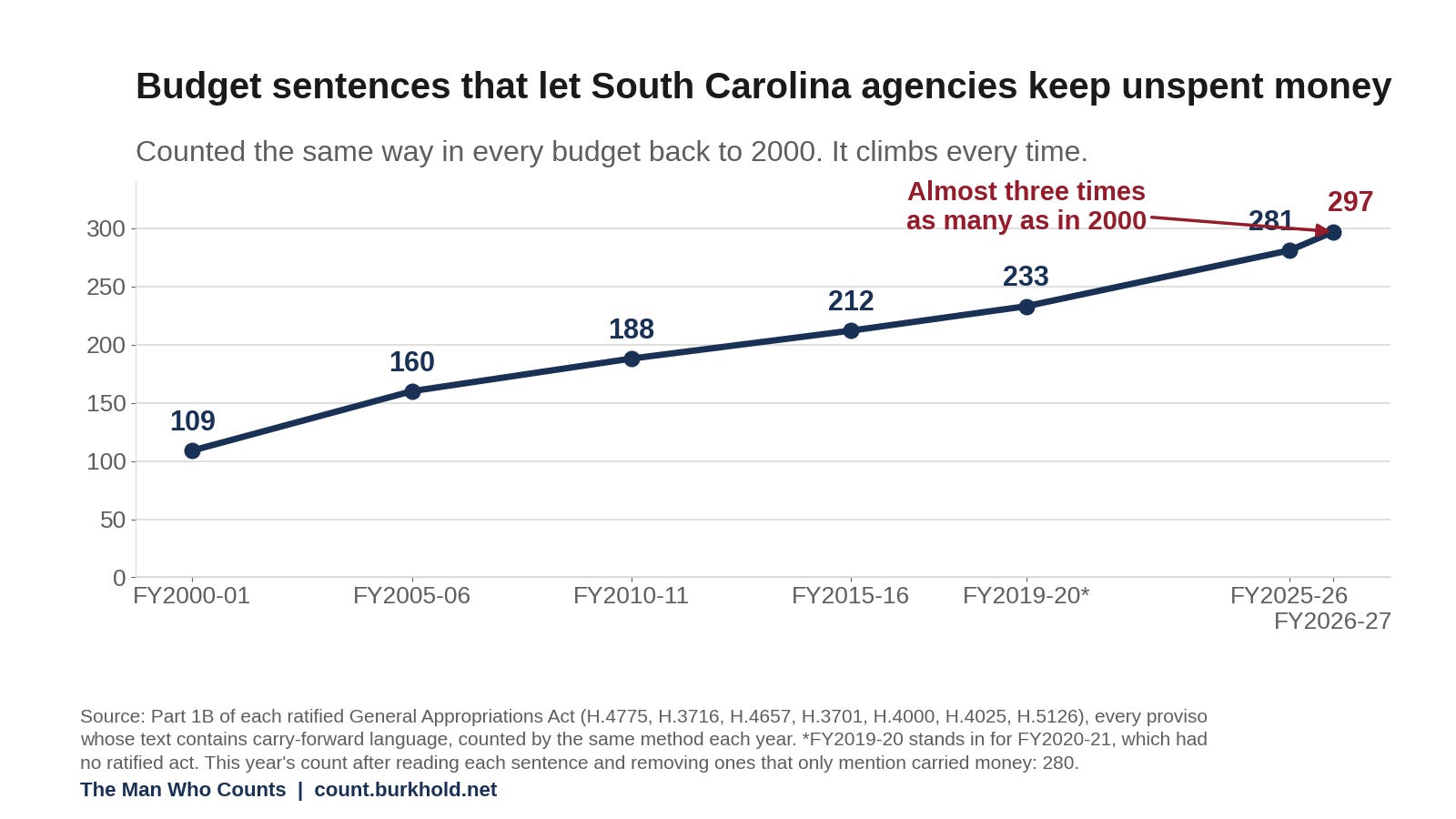
It goes like that every year. Count the sentences the same way in every budget back to 2000 and the number climbs every time: 109, 160, 188, 212, 233, and 297 today.6
The Department of Corrections “may carry forward any unexpended general fund balance“ for security and operating expenses. The parks agency may keep what it didn’t spend on regional promotions.7 Each is a reasonable sentence on its own, written for one agency and one purpose, and neither says why. Each will be printed again next year unless somebody takes it out, and nobody will write down why then either.
This year the state did the one thing you’d expect to take some out. It merged three agencies, the Department of Mental Health, the Department of Disabilities and Special Needs, and the Department of Alcohol and Other Drug Abuse Services, into one Department of Behavioral Health and Developmental Disabilities. The three old agencies had ten of these sentences between them. The new one has ten. Three of the ten are the same sentence. Each old agency had a proviso letting it keep lease-payment money, and all three came through identical except for which office is named. The legislature merged the agencies and didn’t merge a sentence.8
So who keeps track of 280 sentences? Not the numbering. This year 88 provisos in the education section changed numbers without changing a word, because a deleted proviso left a hole that got closed. A sentence about school money that was 1.30 last year is 1.29 now, and 1.30 is a rule about bus advertising. Nothing on the page says so.9
It works like the notes on your refrigerator. Somebody tapes up a new one now and then: a dentist’s number, no dishwasher after ten. Nobody takes one down. After enough years the door is paper. One of the notes is for a dentist who retired. The state’s refrigerator has 280 notes that say keep this, and one, taped up this year, that says throw this out when the year ends.
The money under those notes started as yours. It came out of your paycheck before you saw it, and while it was yours you knew where every dollar went. The sentence that keeps it with an agency was written once and voted on once, inside a bill of almost six hundred pages. It has been printed again every year since, and every vote since has been on the whole bill, never on the sentence.
Some of the 280 are doing what a careful family does when it sets money aside. Some are holding money nobody has looked at since the year the sentence was written, and nothing in the budget tells you which is which. The legislature wrote every one of them, so it is the only body that can take one back, and this year it proved it can with one sentence that makes money expire. Once all 280 sit on one list next to the one that says no, each with its agency, the balance under it, and the years it has been printed, your representatives can decide which deserve to stay. If I am elected Comptroller General, my office will publish that list every year.
Next week: SC Agencies have Home Field Advantage
Last week:
Keeping $3.12 Billion in Change

Fourth in a series on provisos, the short instructions in the state budget that move money and keep it moving.
Proviso 92D.3 (SCOR: Carry Forward), printed page 469: "The Office of Resilience shall be authorized to carry forward unexpended funds from the prior fiscal year into the current fiscal year and expend the funds for the same purposes." Proviso 92D.5 (SCOR: Captain Sam's Spit), same page: "Any funds appropriated or authorized in this act for the acquisition of property or settlement of litigation related to Captain Sam's Spit shall expire at the end of the fiscal year and may not be carried forward or reauthorized without the approval of the General Assembly through subsequent legislation." A programmatic search of both acts for language forbidding carry-forward returned four candidates in the new act; read in full, the other three are a scope carve-out (65.30), an exemption from fiscal-year limits (81.2), and a prohibition on withholding services in order to carry funds (117.23). 92D.5 is the only proviso in either act that stops money from carrying forward, and it has no counterpart in the FY2025-26 act.
On the lapse rule: the State Treasurer's audited financial statements for the fiscal year ended June 30, 2025, note 2, state that unexpended State General Fund monies as of June 30 automatically lapse to the State General Fund on July 1 unless the General Assembly authorizes carrying them over to the next fiscal year.
The count is of provisos that grant an agency authority to carry unspent money past June 30, compiled from Part 1B of H.5126, the General Appropriations Act for FY2026-27, as ratified August 11, 2026 (R.276), and hand-checked row by row against the ratified text on September 3, 2026. That act's count is 280. The prior year's count, 269, is from Part 1B of H.4025 as ratified, hand-checked August 11, 2026, and is the figure this series published on August 25. The same parse produced both counts and was validated by reproducing the August figures exactly. Sentences that mention carried-forward money without granting the authority to carry it are excluded from both counts under the same rule; there are 17 such sentences this year and there were 12 last year. Thirteen provisos in the new act grant carry-forward authority with no counterpart in the old act; two provisos in the old act granting it have no counterpart in the new one. One title change, the Rural Teacher Recruiting Incentive becoming the Rural Teacher Recruiting and Retention Incentive, is treated as the same proviso.
The Governor vetoed fourteen items in H.5126 on August 17, 2026. As this piece publishes, the General Assembly has not acted on those vetoes. One of the 280 provisos counted here, 1A.69 (High-Dosage Tutoring), is among the vetoed items. If that veto is sustained the count becomes 279. The count reported here is the act as ratified.
The $3.12 billion is the Office of the Comptroller General's year-end report, August 18, 2026, "Budgetary General Fund, Appropriations and Expenditures, Fiscal Year Ended June 30, 2026 (Unaudited)," report page 4, appropriations carried forward to 2027: $3,123,389,420. The same report's page 5 sorts it into $2,945,996,546 of special carry-forwards, which it defines as balances that provisos in Part 1B allow certain agencies to carry forward, and $177,392,874 under proviso 117.23's general ten percent authority. The pairing of this balance with this year's 280 sentences follows the basis this series used on August 25: the sentences counted are the permissions in force while the money is held, and 117.23 is one of the 280.
The seven-year series counts every proviso whose text contains carryforward language, by the same programmatic method in each ratified act: FY2000-01 (H.4775) 109; FY2005-06 (H.3716) 160; FY2010-11 (H.4657) 188; FY2015-16 (H.3701) 212; FY2019-20 (H.4000, standing in for FY2020-21, which had no ratified act) 233; FY2025-26 (H.4025) 281; FY2026-27 (H.5126) 297. The 269 and 280 in the body are the two most recent years after a second pass in which each row was read and rows that mention carried money without granting the authority to carry it were removed. That second pass has not been run on the five earlier years, so the series is stated on the uniform first-pass basis; on that basis last year is 281 and this year 297.
The two new provisos quoted: 65.31 (CORR: Carry Forward Authorization), printed page 441; 49.23 (PRT: Regional Promotions Carry Forward), page 406.
The merger: Sections 35, 36, and 37 of the FY2025-26 act became Section 34 of the FY2026-27 act, J080, Department of Behavioral Health and Developmental Disabilities. Ten carry-forward provisos in the three old sections; ten in the new one. The lease provisos are 34.12 (Office of Mental Health), 34.26 (Office of Intellectual and Developmental Disabilities), and 34.33 (Office of Substance Use Services), printed pages 381, 383, and 384, each carrying the sentence "These funds shall be carried forward into the succeeding fiscal year and used for the same purpose." Their FY2025-26 predecessors were 35.12, 36.13, and 37.6.
The renumbering: in the FY2025-26 act, proviso 1.19 printed the word "DELETED." In the FY2026-27 act the sequence closes over it. Of 106 Section 1 provisos matched across the two acts, 88 carry different numbers and 18 carry the same. Proviso 1.30 (SDE: State Aid to Classrooms Reserve Fund) in the FY2025-26 act, printed page 281, is 1.29 in the FY2026-27 act, printed pages 279 to 280; 1.30 in the new act is SDE: Prohibit Advertising on School Buses. Act-wide, 298 provisos kept their exact title and changed number.