


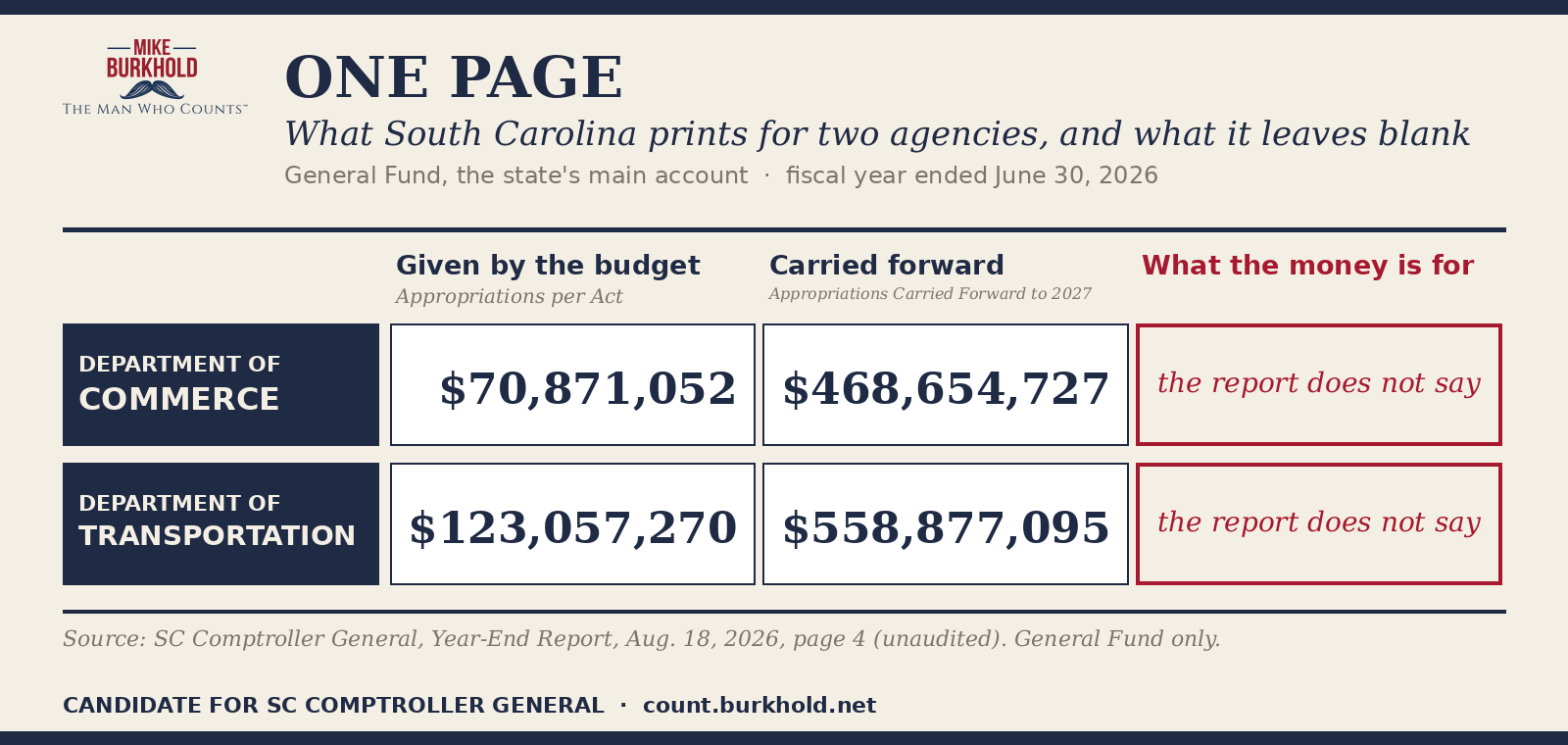
Last year’s state budget gave the Department of Commerce $71 million from the General Fund, the state’s main account. When the year ended June 30, Commerce carried $469 million forward.1
Money an agency has not spent by June 30 normally goes back to the General Fund. Carried forward means a sentence in the budget let the agency keep it instead, this year’s money and money from earlier years too. The Comptroller General’s year-end report prints Commerce’s $469 million balance to the dollar. It does not say what the money is for.
The same department runs the state’s business incentives, the grants and tax credits offered to companies. In 2020 the state’s auditors recommended that Commerce look back and measure what the incentives returned. In 2024 Commerce answered that it “has not found a credible way” to do it.2
The $469 million and the incentive money are separate sums. What they share is a blank where an answer should be.
Some of the money agencies keep is roof money, the kind a careful family sets aside in March for a roof that goes on in September. A careful agency does the same. The people who write the budget may already have a list of what each balance is for. If they do, printing it costs nothing.
The budget, almost 600 pages, is written to give agencies permission to spend. The state’s annual financial report, 316 pages, is written to satisfy accounting standards. The Comptroller General’s year-end report, 10 pages, is written to close the books. That is more than 900 pages. Not one was written to answer a taxpayer’s question. So none of them does.3
Agencies carried $3.12 billion forward last year. What is that money for? The year-end report gives one total for each agency and no reason beside any of them.4
You can answer that question about your own money, because your bank sends you a statement every month without being asked. The statement shows what was there, what came in, what went out, and what is left. You never filed a records request for it. The state’s year-end report is that statement with everything above the totals torn off. It shows what each agency was cleared to spend, what it spent, and what it kept. It does not explain why that money was kept and what the agency plans to use it for.
One office keeps the book these dollars are written in. A state law that traces all the way back to the year 1834 says the Comptroller General “shall keep a book in which all appropriations by the General Assembly shall be entered, with all payments made under them.” Agencies send their bills to his office, his office approves them, and the Treasurer pays.5 So the page the state is missing is his to print.
That page has one line for every balance an agency kept. Each line says how much the balance is and gives enough detail for a citizen to understand what the money is to be used for.
The dollars are already in the state’s books, so the cost is the work of putting them on the page. What the books may not hold is what each balance is for. If I am elected Comptroller General, my office will publish this page every year. If the accounting system does not hold the detail yet, I will work to see that it does. Nothing I found in the office’s own law or in the budget stops it from printing any of this.6
What happens to the money on the page is the legislature’s call. Whatever it decides, the public and the legislature should be able to see the money, and the legislature should look at it every year. The page puts it on the table.
Some of that $3.12 billion in our tax dollars is being held for important projects that take years to finish. Some could be left over from projects that are long dead. From what the state publishes, there is no way to know how much is which. That is the whole point. The page is how anyone tells which.
You counted that money to the dollar when it was yours. It came out of your check before you saw it. For the money you kept, your bank sends you a statement every month. For the money you sent to Columbia, one page is the least owed back.
South Carolina is a great state that can be the best-run in the country. A state that can hand any taxpayer that page is a state worth bragging about. The page is the Comptroller General’s to print. Printing it is the job I am asking for.
Next week: South Carolina Can End the Income Tax Without Raising Another One
Last week:
SC Agencies Have Home Field Advantage

Sixth and last in a series on provisos, the short instructions in the state budget that move money and keep it moving.
Office of the Comptroller General, year-end report, August 18, 2026, “Budgetary General Fund, Appropriations and Expenditures, Fiscal Year Ended June 30, 2026 (Unaudited),” report page 4, Commerce: appropriations per act $70,871,052; appropriations carried forward to 2027 $468,654,727. Page 5 sorts the carried-forward amount into $464,914,835 of special carry-forwards, which the report defines as balances that provisos in Part 1B of the Appropriations Act allow certain agencies to carry forward, and $3,739,892 under proviso 117.23’s general authority. These are General Fund figures only; the department also spends federal and other funds. Footnote b on page 4 says adjusted authorizations exceed appropriations per act statewide because of “prior year carryforwards, current year supplemental appropriations, lapses per proviso, open-ended appropriations, governor vetoes and other budget adjustments,” and gives no breakdown by agency.
Legislative Audit Council, Follow-Up Report, August 2024, Review of Incentive Programs Administered by the S.C. Department of Commerce, page 2, Recommendation 10: the department “should conduct a ‘look back’ analysis of the fiscal impact of projects approved for grants and job development credits.” Status: not implemented. The department “has evaluated this recommendation and has not found a credible way to conduct an effective ‘look back’ analysis for any given project.” The recommendation was made in the Council’s June 2020 review. Job development credits are tax credits, not appropriations, and neither they nor the grants are the carried-forward balance in note 1.
H.5126, the FY2026-27 General Appropriations Act as ratified August 11, 2026 (R.276; Act 259 of 2026), runs 265 pages of Part IA, a two-page statement of revenues, and 325 pages of Part IB, printed pages 1 to 592. The State of South Carolina Annual Comprehensive Financial Report for the fiscal year ended June 30, 2025, runs 316 pages. The year-end report in note 1 runs ten. Together, 918. On what each is written to do: the act’s title is “to make appropriations ... to regulate the expenditure of such funds”; Proviso 97.2 of the same act, page 475, states the intent “that the State of South Carolina issue financial statements in conformance with Generally Accepted Accounting Principles”; the August 18 release opens “South Carolina closes the 2025-26 fiscal year.”
Year-end report, page 4, Total line: appropriations carried forward to 2027, $3,123,389,420. Page 5 sorts it into $2,945,996,546 of special carry-forwards and $177,392,874 of general carry-forwards and states no purpose, authorizing proviso, or age for any balance.
S.C. Code § 11-3-50, quoted in the body; its history note runs to 1834. § 11-3-100: the Comptroller General’s books are “a transcript of the books of the Treasury, constituting a complete check upon that office.” § 11-3-130: payments by the State Treasurer, “except for interest on the public debt and the pay of officers, members and attaches of the General Assembly, shall be made on warrants drawn by the Comptroller General.” § 11-3-185: on a requisition with “invoices or other satisfactory evidence of the propriety of the payment,” the Comptroller General “shall issue a warrant on the State Treasurer.” § 11-3-140: the Treasurer “shall then make payment of the obligation by check.” H.5126, Part IB, Proviso 97.2, page 475: “the Comptroller General is directed, as the State Accounting Officer, to maintain an Enterprise Information System for State Government (SCEIS).”
What was searched: all twenty sections of Title 11, Chapter 3 of the S.C. Code, and all 1,353 provisos in Part IB of H.5126 as ratified. No section or proviso restricts what the Comptroller General may publish. Three provisos pair the office with disclosure language (1.20, 1A.13, 117.26), and each requires publication. The state’s Freedom of Information Act exemptions were not reviewed; they govern individual records, not totals.