


Second in a series on provisos, the short instructions in the state budget that move money and keep it moving.
Every year South Carolina publishes its financial report, and every year, in the notes, it prints the same sentence: “Unexpended appropriations lapse on July 31 unless the department or agency is given specific authorization to carry them forward to the next fiscal year.” Money an agency did not spend goes back, unless somebody gave it permission to keep it.
Word for word, in every report from 2009 through 2025. We pulled all seventeen and read the page in each.1
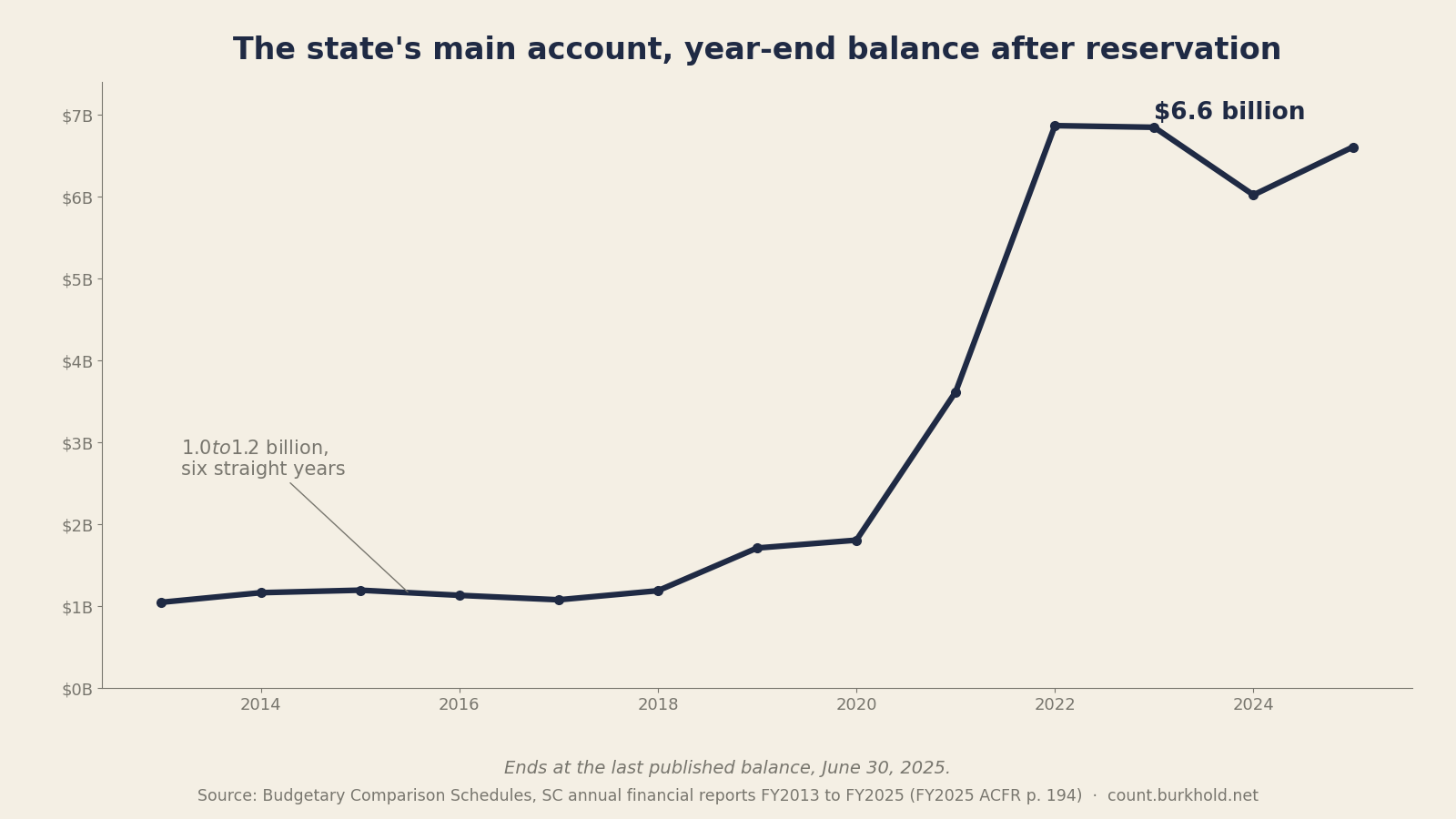
In the first of those years the state’s main operating account, the one that sentence governs, ended with $120 million in it. In 2025 it ended with $6.6 billion.2 Same rule, 54 times the money.
The money did not creep up. For most of that run the account behaved the way the rule suggests it should. It held $120 million in 2009 because the recession had drained it, which is what a cushion is for. It rebuilt over the next three years to about a billion dollars, and then it sat. From 2013 through 2018, six straight years, it stayed between $1.0 and $1.2 billion.3
Then two years moved it and nothing has moved it back. In 2019 it climbed to $1.7 billion. In 2021 it doubled. In 2022 it nearly doubled again, to $6.9 billion.4 The money came from a boom in state tax collections. When it landed, what did the system do with it?
It absorbed it. It has kept it every year since.
None of this needs a villain to explain it. An agency keeps money it is not spending for the reason you would give in its place. A cushion means a bad year does not become a crisis, and a lean budget does not become a layoff. An agency head who could build one and didn’t would be failing his own people. And this is not a government trait. I ran a company for seventeen years, and pushing back on departments that wanted more was my job. Once a year somebody sat down with each one and asked what it needed, and that conversation was the only reason money came back. Nobody looked forward to it. In state government that job belongs to the legislature.
And the state does pull money back sometimes. The same note that carries the lapse rule also lets the budget office cut spending the legislature already approved, if that is what it takes to prevent a deficit.5 A bad enough year spends the cushions, the way 2009 did, and 2024 took more than $800 million off the balance. A vote can do it too: a billion dollars went back to taxpayers in 2023.6 Every one of those took a crisis or a decision. Nothing sends money back on its own.
What the $6.6 billion is for depends on which part you mean. About $1.4 billion of it is set aside in the three reserve funds the state counts, and those are filled by rule and reported in one place. The rest is the $3.4 billion agencies kept under sentences in the budget’s fine print and $1.7 billion assigned to nothing.7 No formula sets either one, and no document says what the right level would be.
None of that money went anywhere. It is all in the one account, and what carries forward is the permission to spend it.8
The same habit runs in your own house in a smaller way. Somewhere on your bank statement is a charge that renews every month for something the family quit using a long time ago. Renewing takes nothing. Stopping it takes a decision, an account, and a phone call. So it renews, and not because anyone wants it. The budget works the same way.
Nobody has any incentive to send money back.
Outside a crisis, only the legislature can send kept money back to the General Fund, the state’s main account, and that has to happen every year, as a habit, because the keeping happens every year, as a habit. But nobody sends back a total that never reaches the budget. The sentences pass one at a time, each easy to defend on its own, and the total never lands on a page. A number nobody adds up is a number nobody can act on.
That money started in your paycheck. It came out before you ever saw it, and while it was yours you knew what every dollar of it was for. It has sat since in an account that grew 54 times over under a sentence that never changed a word. You counted it when it was yours. As Comptroller General, I will count it every year and publish the total.
Next week: Follow the Bus Money
Last week:
The Pile of Money

On page 398 of South Carolina’s 2025-2026 budget there is a sentence about advertising money. The state’s parks and tourism agency “may carry forward any unexpended funds” on its advertising line into the new year, to spend on the same things. It is the boring kind of sentence nobody stops to read. The budget holds 269 sentences like it, each letting an…
The proviso file behind this piece was built by the campaign’s volunteer research team. The work in this series is theirs as much as mine.
"Unexpended appropriations lapse on July 31 unless the department or agency is given specific authorization to carry them forward to the next fiscal year." Notes to Required Supplementary Information, Budgetary, Note 4, in the state's annual financial report for each fiscal year 2009 through 2025. FY2025 edition, printed page 199; FY2016 edition, printed page 172. The sentence is identical in all seventeen editions. The same rule appears in different words as far back as the FY2000 report, transmittal letter, pages 14 and 15.
$120,512,000 at June 30, 2009 and $6,604,224,000 at June 30, 2025. Budgetary Comparison Schedule (Non-GAAP Budgetary Basis), Budgetary General Fund, page 145 of the FY2009 report and page 194 of the FY2025 report. The schedules print in thousands, so on the page these read 120,512 and 6,604,224. The presentation changed during these years: the FY2009 schedule ends at the budgetary ending balance, and a reservation section appears in later editions. The FY2025 figure is the balance after reservation, which is the figure this series uses for every year that states one; FY2025's ending balance before reservations was $6,246,805,000. This is the state's own published schedule; it sits in required supplementary information rather than under the auditor's opinion, and it is checkable by anyone. The state reports the General Fund a second way in the same report, on a broader accounting basis that sweeps in money the budget handles separately. Both are correct. This piece uses the budget version throughout, because that is the account the legislature votes on and the one the leftover sits in.
Same schedule, each year’s report: $1,046,090,000 (2013), $1,163,275,000 (2014), $1,193,825,000 (2015), $1,131,309,000 (2016), $1,076,471,000 (2017), $1,187,174,000 (2018). The rebuild years were $246,167,000 (2010), $711,742,000 (2011), and $1,053,039,000 (2012). The FY2012 schedule states its ending balance before the reservation presentation appears in later editions, so 2012 is described here only as about a billion dollars. The 2009 low is the recession’s: the FY2009 report’s Management’s Discussion and Analysis, printed page 29, states that the year ended in a budgetary deficit, that the deficit was funded by drawing down the entire General and Capital Reserve funds, and that revenues fell $848,221,000, or 13.23 percent, from the prior year.
What this series measures is the whole budgetary General Fund ending balance, which the state publishes on the same basis every year. It is not a measure of agency carryforward by itself. Carryforward is one component of the balance, $3,426,000,000 of the $6,604,224,000 at June 30, 2025, and the state states that composition in its transmittal letter rather than on the schedule. A year-by-year series of the carryforward component alone would be a different series and could have a different shape. Nothing here is a claim about it.
$1,708,756,000 (2019), $1,804,723,000 (2020), $3,615,308,000 (2021), $6,865,938,000 (2022). The 2022 figure is the highest in the series; the account stood at $6,845,879,000 in 2023, $6,019,850,000 in 2024, and $6,604,224,000 in 2025.
"The authority to reduce enacted appropriations is provided to the Executive Budget Office if it is deemed necessary to prevent a deficit." FY2025 Annual Comprehensive Financial Report, Notes to the Required Supplementary Information, Budgetary, Note 2, printed page 199, the same page that carries the lapse rule quoted above. The budget office referred to is the Executive Budget Office. The same note adds that the State Board of Economic Advisors may approve revisions of estimated revenues for the Budgetary General Fund during the year.
The balance fell $826,029,000 between June 30, 2023 and June 30, 2024, and that year's spending ran $747,661,000 ahead of that year's revenue. The $1 billion taxpayer rebate appears in the reservation detail of the FY2023 schedule. Same schedules and same basis as the figures above, in the FY2023 and FY2024 reports.
Composition of the $6,604,224,000 as of June 30, 2025, from the FY2025 report's transmittal letter, page 9: agency carryover appropriations approved by the legislature $3,426,000,000; General Reserve Fund $739,568,000; Capital Reserve Fund $369,784,000; Contingency Reserve $332,294,000; unassigned surplus $1,736,000,000.
The general carryforward proviso authorizes each agency "to carry forward unspent general fund appropriations from the prior fiscal year into the current fiscal year, up to a maximum of ten percent of its original general fund appropriations less any appropriation reductions for the current fiscal year." H.4025, General Appropriations Act for FY2025-26, Part 1B, Proviso 117.23, as ratified, page 506, confirmed against the rendered page image August 13, 2026. An appropriation is authority to draw money from the General Fund, so what carries forward is that authority over money held in the fund. The state's own reporting shows the same thing from the other side: the carried-forward total is stated as a component of the General Fund's ending balance rather than as a transfer out of it.