


The state’s auditors did something unusual in their December 2024 review of USC. They drew a cartoon. Four panels, with a thought bubble. When auditors resort to drawing pictures, it’s because the thing they found is easier to believe if you can see it.
Here’s what the panels show.
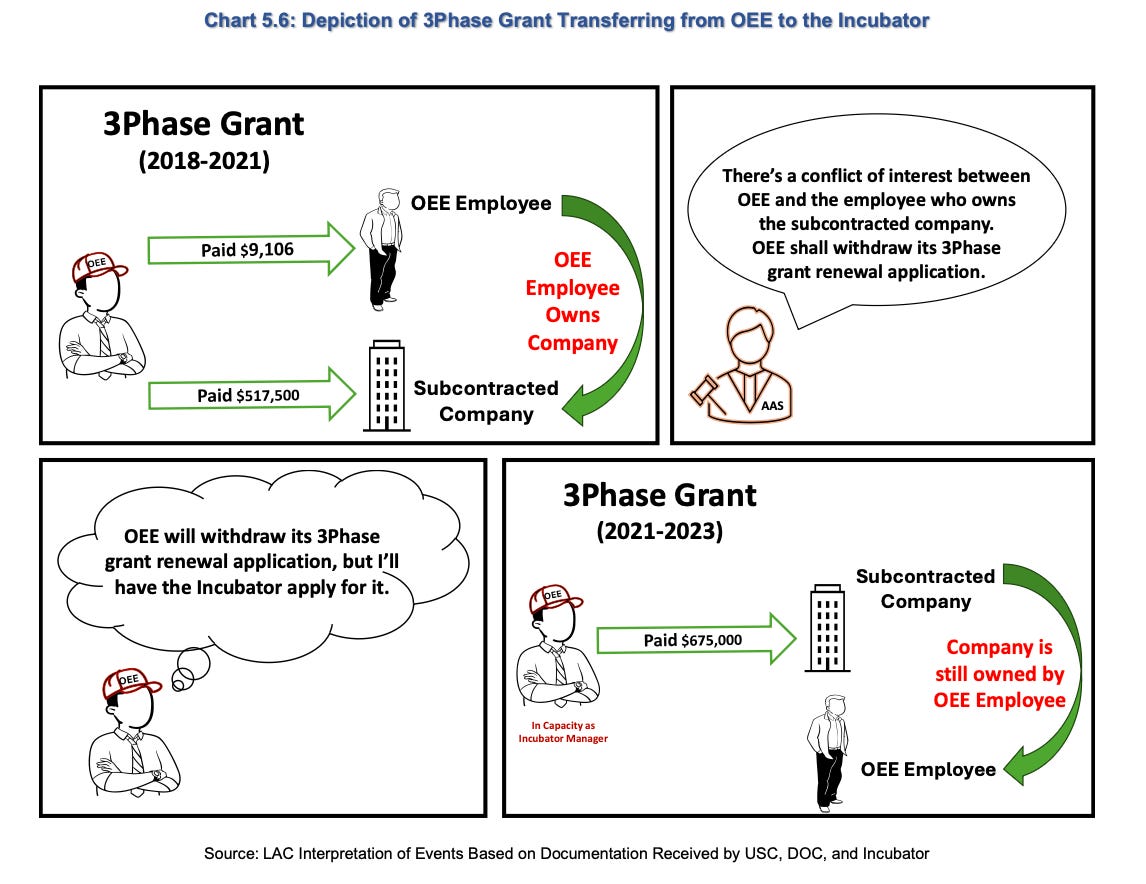
An employee in USC’s economic engagement office owned a private company. That company was hired onto a state grant the same office ran, as a paid subcontractor, for $517,500. The chart shows the grant also paid that employee $9,106 directly, on top of what his company got. University policy says a conflict like that has to be disclosed. It wasn’t.
In April 2021, the university’s own audit office caught it. It found the conflict, found that an official had never disclosed it, and called that a violation of USC policy. In plain terms, the university said no. An office paying a company its own employee owned could not stand.
Now watch what the official did with that no.
He withdrew the university’s application to renew the grant. On paper, that’s compliance. But he had a second job: manager of the nonprofit next door, the USC/Columbia Technology Incubator. The Incubator doesn’t run on USC’s purchasing rules or USC’s conflict policy. And keep in mind what those rules are. They’re not red tape. They’re the public’s only say in how its own money gets spent. So he took the grant there, without the auditors knowing, and signed the contract himself as Incubator manager. The grant came back in through the nonprofit’s door. Then the Incubator hired the same company, owned by the same coworker, for the same kind of work. Only now it was $675,000 instead of $517,500.
Told no, he didn’t argue. He just moved the deal next door, where the no couldn’t reach him, and did it anyway. Bigger.
The auditors reconstructed his plan from the documents and put it right in the cartoon, in a thought bubble over his head: withdraw the university’s application, have the Incubator apply instead. He didn’t stumble into a loophole. He walked to it.
Any parent knows this move. You tell your son he can’t buy that video game. So he hands the money to his best friend, the friend buys the game, and it stays over at the friend’s house. When you find out, he tells you he didn’t buy it. And technically, he didn’t.
Now listen to USC’s answer. The university says some of what the auditors flagged happened at organizations it doesn’t legally control, the Incubator among them. That’s the friend’s house. And it might even hold up, except for one detail: the man who moved the grant there was a USC official, and he was a manager at the friend’s house too. He signed for the university one day and for the nonprofit the next. “We have no control over that organization” is a strange defense when the man who signed its contract was your own official.
And here’s the question this story leaves me with, the one I can’t shake. Did this official invent the move, or did he learn it somewhere? Is parking a deal in the nonprofit next door a trick one man figured out, or is it how business gets done around our public universities when the rules say no? How many other grants have made this same trip?
I can’t tell you. Nobody can. And that’s not a dodge, it’s the finding. The university’s books and the nonprofit’s books are separate, and no one in this story could read both at once. The auditors only caught this one because senators ordered a review. Every other deal that walked out the university’s door and in through a nonprofit’s is sitting in a set of books nobody’s required to open.
The gap between the university’s books and the nonprofit’s books is where this money disappeared from view. It started as yours, taken from your paycheck without anyone asking. The rules were the only protection you were promised. This deal slipped through a door those rules never covered. It was counted only once, three years later, because senators ordered a special review the normal system never requires.
Luck is not a bookkeeping system. The Comptroller General keeps the state’s books, and those books record money the moment it leaves an agency, including money that goes to a nonprofit next door. Making those transfers visible, agency by agency and in plain numbers, is the job I’m seeking.
Next week: The Money That Never Came Back
Last week:
The Eight Who Never Worked

Eight people were paid from the computer lab grant. All eight told the state’s auditors they never worked on it.
The Eight Who Never Worked
Source: South Carolina Legislative Audit Council, A Review of the Office of Economic Engagement of the University of South Carolina and its Affiliation with the USC/Columbia Technology Incubator and the South Carolina Research Foundation (December 2024), pages 104–106 and Chart 5.6. Read it: https://lac.sc.gov/node/271
Brazen scoundrels need to be fired (if not prosecuted). Accountability!!
Mike, I hope you are getting good feedback and views. I’ll do my part to spread the word.