


The Money That Never Came Back
When a company takes a grant from South Carolina and does not deliver the jobs it promised, the contract already says what happens next. There is a formula, written into the deal, for how much of the money the state takes back. Over the ten years auditors examined, that formula meant the state could have demanded about $17 million from companies that fell short. The state asked for $9.3 million, collected $7.8 million, and wrote off $5.2 million as money it will never see.
Those numbers come from one document: the Legislative Audit Council’s June 2020 review of the incentive programs run through the Department of Commerce. The state pays companies to move here or expand, in exchange for a promise: this many jobs, this much investment, by this date. A body called the Coordinating Council for Economic Development approves the grants, and when a company falls short, the Council collects. And the Council is supposed to be working for you. You are the one who put up the money.
The Council’s own newest report has good news for the program, and that goes first. By the Council’s count, the 289 grants finished over the last decade created 115 percent of the jobs they promised and 139 percent of the promised investment. On paper, most companies over-deliver. The program is not a failure, and this piece is not about the companies that kept their word. It is about the smaller pile, because the smaller pile is where you find out what happens when a promise to you gets broken.
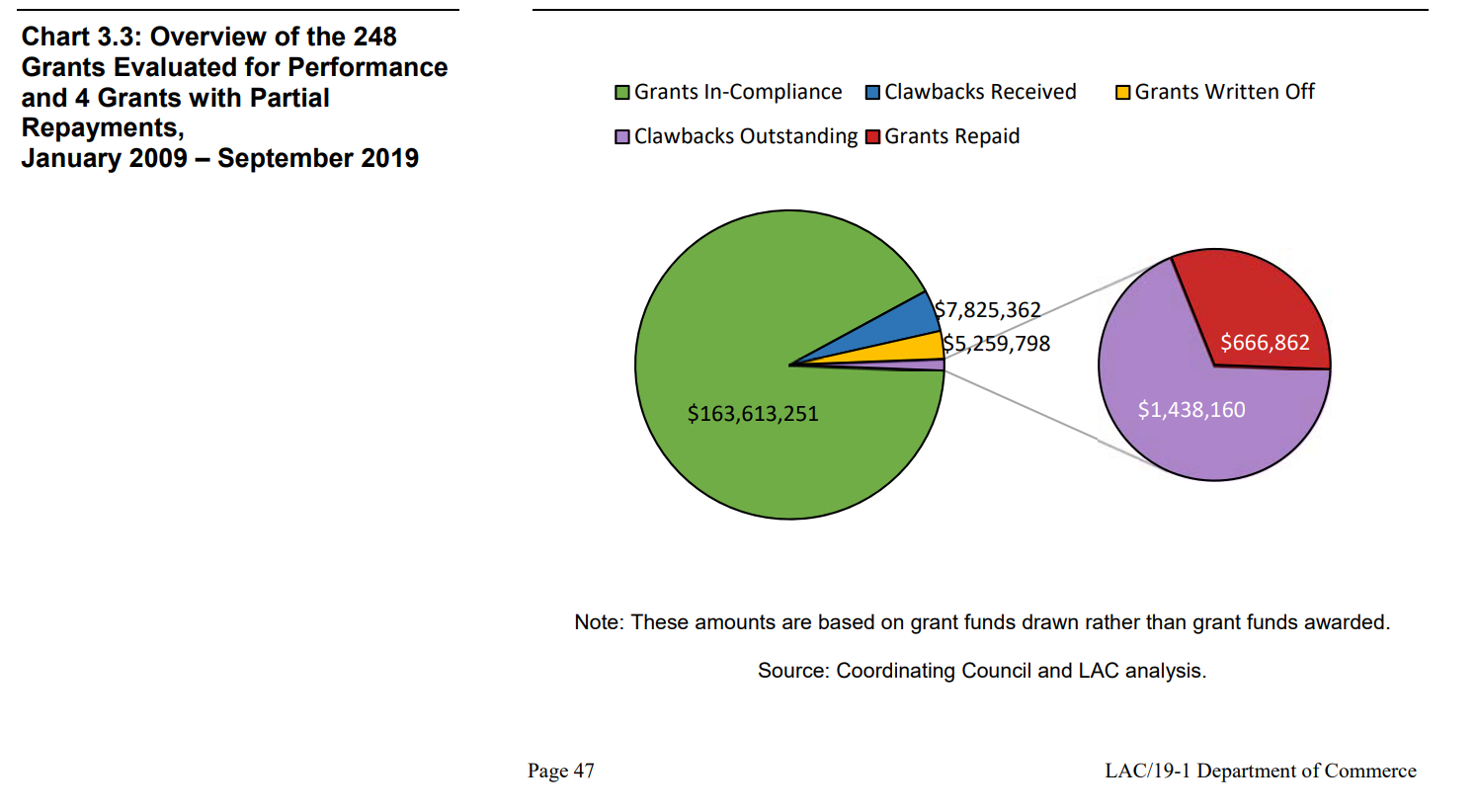
Start with why the state asked for $9.3 million when its own formula supported $17 million. The contract has a second clause. A company that falls short can hand in paperwork showing it made a good-faith effort, and if the county that received the grant and the Council decide, in the contract’s words, “in their sole discretion,” that the circumstances excuse the shortfall, the agreement gets rewritten to match what happened. The state’s auditors read that clause and said plainly what it amounts to: flexibility to reduce or waive any repayment that would otherwise be required. Their words, page 46. About $7.7 million of the gap between could-have and did is that clause at work.
What counts as an excuse? The auditors asked that too, and a Commerce staff member gave examples: job requirements are hard to fill in rural counties, South Carolina’s low unemployment makes it hard for some companies to find workers, construction runs late, and downturns change business plans. Some of those are real hardships; a rural county’s labor pool is what it is. But look at the whole list together. Between a thin rural labor pool and a booming state’s empty one, it covers every county in every year, and delays and downturns cover every project in every economy. An excuse list that broad means the company is never really on the hook. The risk lands back on the person the formula was supposed to protect, and that person is you. And the second excuse deserves one more beat: the program exists because the state wants more jobs, and the excuse it accepts for missing jobs is that there was nobody left to hire.
Now ask who holds the discretion. The Council has thirteen seats, with the Secretary of Commerce in the chair. Ten belong to agency heads and appointed board chairmen. One statewide elected official has a seat, the Commissioner of Agriculture. And in 2021, the budget year after this audit landed, the legislature added the chairmen of its two budget committees, putting its own eyes in the room. None of that is a knock on anyone at that table. It is just how the table is built: when a debt owed to you gets forgiven, this is the room that decides, ten of its thirteen members answer to no voter, and the only people who check the forgiving are the people doing it.
Then there is the $5.2 million the state billed for and gave up on. In the years the auditors examined, when a company quit paying or quit answering, nothing followed, because nothing had to. Since then the Council has added a tool: dead debts now go to the state’s tax-collection program, called GEAR. Its whole history: 26 companies sent there, $887,426 brought back. In one file closed last year, GEAR recovered exactly $53, and the Council wrote off the remaining $168,697. And the clause is still in use: in 2025 the Council waived or wrote off four repayments totaling $352,475. Credit where it is due, and it is due: every number in this paragraph is public because the Council itself publishes it.
Now say it in household terms. Suppose you handed your savings to a man to lend out for you, under signed agreements that spell out exactly what each borrower owes back if he breaks his promise. Then you learn the fine print lets that man forgive any debt he wants, on his own say-so. And when a borrower stops paying, the man you hired hardly ever collects a dime. You would fire that man by Friday. Not because he is dishonest, but because you would never know if he were.
The auditors did not find a villain running the program, and the story does not need one. They found a repayment formula that was a suggestion, an excuse list that covers every county in every year, and a discretion nobody above the room reviews. How the money went out in the first place is a story of its own, and it is next week’s. You counted every dollar of that money while it was yours, because it was yours. Once it crossed into the state’s hands, whether it came back at all was left to somebody’s sole discretion, and $5.2 million owed to the people of South Carolina was money nobody ever had to collect.
Next week: The Honor System
The Honor System

When South Carolina pays a company to create jobs and later wants to know whether the jobs exist, it asks the company. That is not a simplification. The state’s auditors wrote it as a finding in 2020: the only evidence the Department of Commerce uses to verify a company’s job creation is documentation provided by the company itself. They printed an exam…
Last week: The Hat Switch
The Hat Switch

The state’s auditors did something unusual in their December 2024 review of USC. They drew a cartoon. Four panels, with a thought bubble. When auditors resort to drawing pictures, it’s because the thing they found is easier to believe if you can see it.
Sources: Legislative Audit Council, Review of Incentive Programs Administered by the S.C. Department of Commerce, June 2020: repayment formula, waiver clause, and staff examples of waiver circumstances pp. 46-47; Chart 3.3 (clawbacks and write-offs) p. 47. Coordinating Council for Economic Development, 2025 Annual Report of Fund Activity, March 2026: membership pp. 4-6; performance history (115%/139%) p. 25; GEAR collections pp. 24, 27 and Exhibit F; 2025 waivers and write-offs p. 27 and Exhibit F.
The question bears asking, if the labor pool was not there to fill the jobs, was that not examined before the deal was made?
I understand the intense competition between states to attract job-creating investments, but rather than grants, why not offer collateralized loans, or even co-signed loans by the company’s shareholders?? Make state incentives contingent on the company meeting goals and objectives. Turn the tables.